Working Memory vs. Short-Term Memory: What's the Difference and Why It Matters
Get the short answer first, then use the benchmarks, examples, and BrainRivals practice links to turn the idea into a measurable result.
Quick Answer
This guide turns an abstract idea about memory into something you can notice, measure, and improve. The fastest way to use it is to read the benchmark first, compare it with your own context, then run a related BrainRivals test under the same conditions for a cleaner before-and-after signal.
Key takeaways
- Start with the practical benchmark, not the trivia.
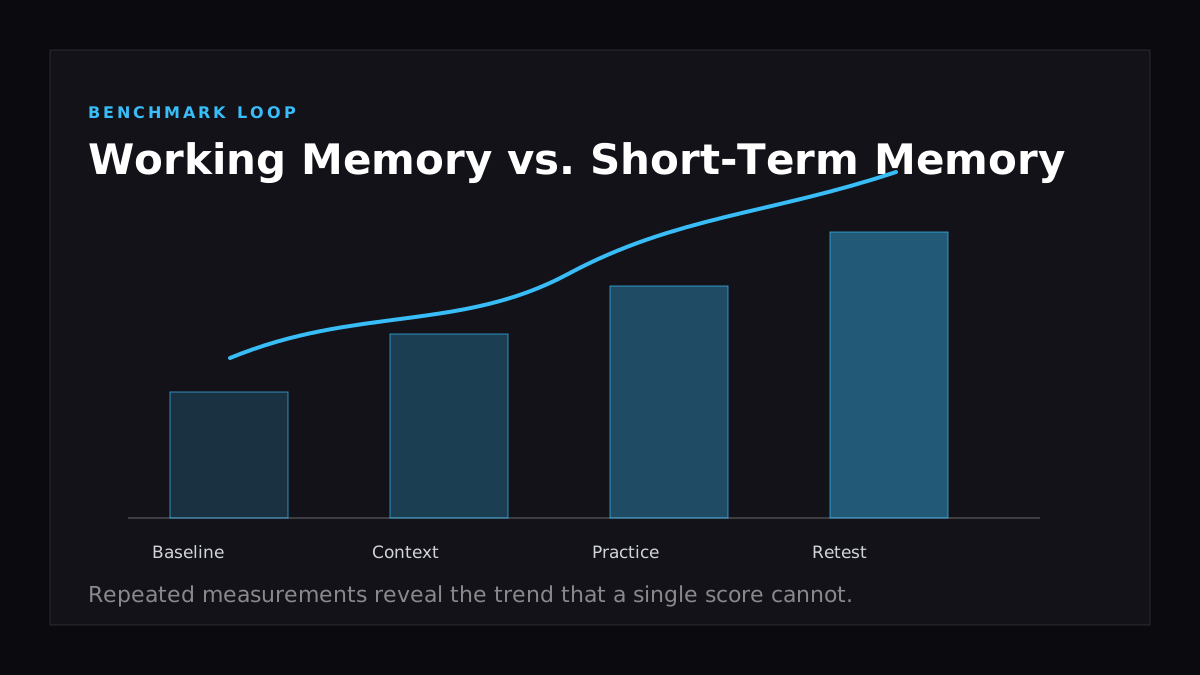
- Treat one score as a snapshot and repeated scores as the real signal.
- Use the Number Memory as the next measurable step.
How to Use This Guide
Use the article in three passes: scan the quick answer, check the tables or examples that match your situation, then pick one action to test this week. That keeps the article useful even if you only have a few minutes, while still giving you enough detail to come back for deeper context.
People use these terms interchangeably, but they're not the same. Short-term memory and working memory are distinct systems with different properties, different neural substrates, and different ways to train them.
Understanding the difference matters because if you're trying to improve your cognitive performance, you need to target the right system. Training one won't necessarily improve the other.
Defining Short-Term Memory
Short-term memory (STM) is the ability to passively hold information in mind for a brief period—roughly 5 to 30 seconds without rehearsal.
Example: Someone tells you a phone number. You hold it in mind long enough to dial it. The information vanishes afterward.
Short-term memory has strict limits:
- Capacity: 5–9 items (what George Miller called "the magical number seven")
- Duration: Seconds, maybe a minute if you actively rehearse
- Function: Temporary holding of information
Short-term memory is simple: information enters, sits there, and decays. It's a buffer. There's no manipulation, no processing, no transformation. Just holding.
Defining Working Memory
Working memory is the system that actively holds and manipulates information to accomplish cognitive tasks.
Examples: mentally calculating 17 × 23, following an argument while taking notes, reordering items in a list, translating a sentence from French to English.
Working memory does the heavy lifting:
- Capacity: 3–4 items (less than short-term memory, because you're working with them)
- Duration: Seconds to minutes (depends on cognitive load)
- Function: Active manipulation of information toward a goal
The difference is critical: short-term memory stores. Working memory stores and manipulates.
Baddeley's Model: The Framework
Alan Baddeley's model of working memory explains why this distinction matters. Working memory consists of multiple subsystems:
Phonological Loop: Holds verbal and acoustic information. Think of it as an inner monologue. This is where you rehearse a phone number. The phonological loop can hold about 2 seconds of speech.
Visuospatial Sketchpad: Holds visual and spatial information. This is where you visualize a rotating 3D shape or remember where you placed your keys. It can hold about 2–3 visual objects.
Central Executive: The "boss" that directs attention, coordinates the subsystems, and manipulates information. This is where real cognition happens. The central executive is the bottleneck limiting working memory capacity.
Episodic Buffer (added later): Integrates information from different modalities and long-term memory into a unified experience.
Here's the key: the phonological loop and visuospatial sketchpad can be trained relatively independently. You can improve verbal working memory without improving spatial working memory, and vice versa. The central executive is harder to train, but possible.
Short-Term Memory vs. Working Memory: A Comparison
| Aspect | Short-Term Memory | Working Memory |
|---|---|---|
| Function | Passive storage | Active manipulation |
| Capacity | 5–9 items | 3–4 items |
| Duration | Seconds (without rehearsal) | Seconds to minutes |
| Rehearsal | Maintains information passively | Maintains information while processing it |
| Complexity | Simple holding | Complex transformations |
| Neural basis | Prefrontal and parietal cortex | Prefrontal cortex (primary), distributed networks |
| Training effect | Moderate improvement possible | Significant improvement possible |
Notice that working memory has lower capacity than short-term memory. This is counterintuitive but makes sense: when you're manipulating information, you have fewer slots available. Your mental resources go toward processing, not just storage.
How BrainRivals Tests Measure These Systems
Number Memory trains short-term memory primarily. You see a sequence of numbers and recall them. There's minimal manipulation—mostly just holding and reciting. As difficulty increases, you're pushing your phonological loop to its limits.
Sequence Memory trains working memory. You don't just hold a sequence; you must anticipate patterns within it. You're actively processing (extracting structure) while maintaining information. This demands the central executive.
Verbal Memory trains both systems. You encode sentences (phonological loop) and work with their meaning (central executive). It's a hybrid task that emphasizes the interplay between simple storage and active manipulation.
This is why sequence memory typically shows larger training gains than number memory—you're training a more flexible, broader system (working memory) rather than a simple buffer (short-term memory).
Training Short-Term Memory
Short-term memory training is straightforward:
Serial Recall: Repeat increasingly long sequences of items. Numbers, letters, words—the modality matters less than consistency.
Chunking: Group items meaningfully (e.g., remembering 1492 as "14-92" or recognizing it as a historical date). This extends capacity by compressing information.
Rehearsal Strategies: Internal repetition and active maintenance. The phonological loop benefits from overt or subvocal rehearsal.
Progressive Difficulty: Gradually increase sequence length.
Short-term memory training produces reliable gains. You can improve from 6 items to 8+ through practice. However, gains plateau relatively quickly—usually within weeks—because you're pushing against a biological buffer limit.
Training Working Memory
Working memory training is more complex because you're training multiple subsystems and the central executive:
Verbal Working Memory: Dual-task paradigms (hold a sequence while answering questions), mental rotation (maintain an image while mentally transforming it), and complex spans (remember words while solving math problems).
Spatial Working Memory: 3D mental rotation, visual pattern tracking, and navigation tasks.
Central Executive: Tasks requiring attention switching, interference resolution (like the Stroop task), and goal updating.
Working memory training produces larger, more durable gains than short-term memory training. People who train working memory often see improvements of 20–40% sustained over months. Gains are more modest than short-term memory at first, but they compound because you're building a more fundamental system.
The Critical Limitation
Here's what trainers don't tell you: working memory training gains don't always transfer broadly.
If you train verbal working memory extensively, your spatial working memory improves modestly. If you train on one task (say, Sequence Memory), your improvement on a different working memory task (like a complex span test) is smaller than on the trained task.
This suggests that working memory isn't monolithic. You're training the central executive in context-specific ways. Gains in one domain transfer somewhat to others, but not completely.
However, recent research is more optimistic. Studies using diverse, progressively difficult training show better transfer than older studies using narrow tasks. The key is training multiple systems and consistently increasing difficulty.
Strategy: Train Both
Rather than choosing one, train both:
-
Short-term memory training (Number Memory) serves as a warm-up and builds the fundamental storage capacity of the phonological loop.
-
Working memory training (Sequence Memory, Verbal Memory) trains manipulation, the central executive, and flexible strategy use.
-
Visuospatial training (Visual Memory tests) ensures you're developing the full range of working memory subsystems, not just verbal skills.
Spending 10 minutes on Sequence Memory produces more cognitive gain than 10 minutes on Number Memory, but combining both—5 minutes on each—trains a broader set of systems and produces better transfer.
The Takeaway
Short-term and working memory are different systems with different properties. Short-term memory is a buffer; working memory is a workshop. You can train both, but working memory training produces bigger cognitive gains because you're training a more fundamental, more flexible system.
For practical improvement in reasoning, problem-solving, and learning, prioritize working memory. But don't neglect short-term memory training entirely—it builds the foundation and often feels easier to track progress on.
The best approach: a mix of progressive, varied tasks that challenge both storage and manipulation.
Test both systems now. Start with Number Memory to measure your short-term capacity, then try Sequence Memory to see how working memory manipulates information under pressure.
Try It on BrainRivals
Reading about the concept is useful, but a repeatable score is more actionable. Run the Number Memory, Sequence Memory and Verbal Memory tests, save your result, then repeat under similar conditions later. The trend matters more than a single best attempt.