Is Brain Training a Myth? The Science Behind Transferability
Get the short answer first, then use the benchmarks, examples, and BrainRivals practice links to turn the idea into a measurable result.
Quick Answer
This guide turns an abstract idea about brain training into something you can notice, measure, and improve. The fastest way to use it is to read the benchmark first, compare it with your own context, then run a related BrainRivals test under the same conditions for a cleaner before-and-after signal.
Key takeaways
- Start with the practical benchmark, not the trivia.
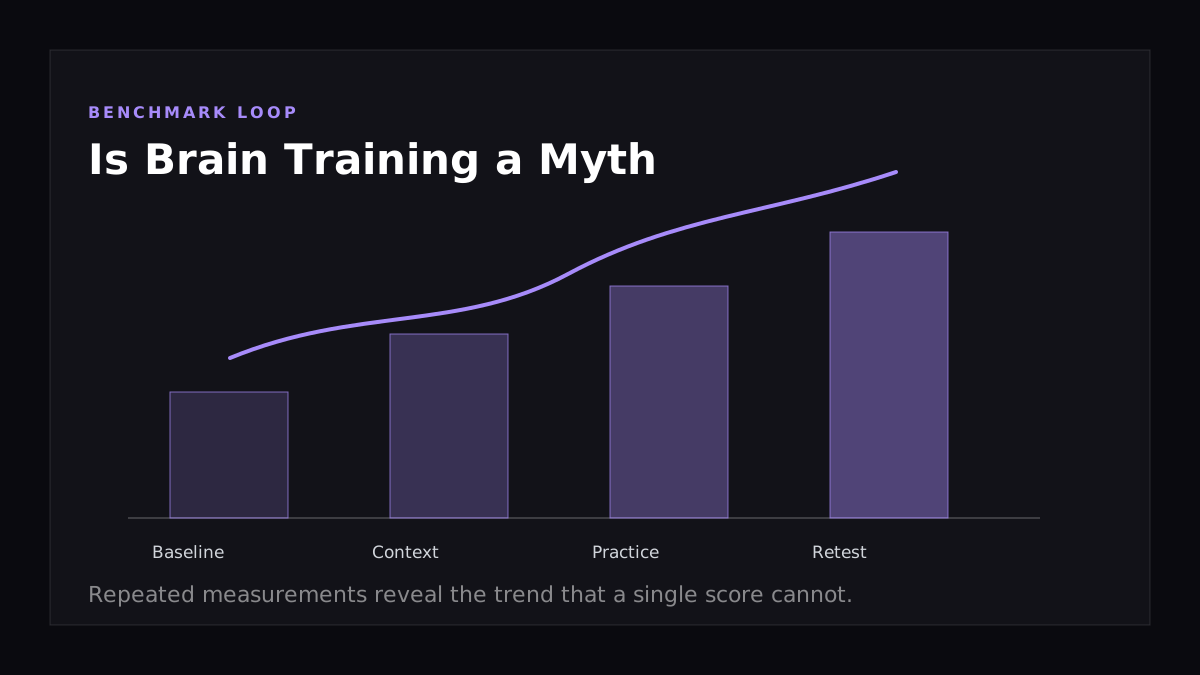
- Treat one score as a snapshot and repeated scores as the real signal.
- Use the Reaction Time as the next measurable step.
How to Use This Guide
Use the article in three passes: scan the quick answer, check the tables or examples that match your situation, then pick one action to test this week. That keeps the article useful even if you only have a few minutes, while still giving you enough detail to come back for deeper context.
In 2014, Stanford released an open letter signed by 70+ cognitive scientists claiming brain training was largely ineffective. The letter went viral. Magazines ran headlines: "Brain Training Games Are Mostly a Scam."
In 2017, the American Psychological Society released a rebuttal: "The Benefits of Cognitive Training Do Transfer."
Who's right?
Both. And neither. The truth is in the nuance that got lost in the headlines.
The 2014 Stanford Open Letter: What It Actually Said
The open letter criticized overstated claims about brain training. The signatories weren't saying brain training doesn't work—they were saying it doesn't transfer broadly.
Key quote:
"Learning in one domain does not automatically transfer to another domain. Improvements in a cognitive training task do not necessarily translate to improvements in other tasks or real-world functioning."
This is a specific critique of far transfer – the idea that training working memory will improve your SAT score, or that reaction time training will make you a better driver.
The research they cited showed:
- Within-domain improvement: Training working memory improves working memory performance ✓
- Far transfer: Training working memory doesn't improve math, reading, or academic performance ✗
This became the mainstream narrative: "Brain training is useless for real-world improvement."
But the narrative oversimplified the science.
The 2017 APS Rebuttal: What Changed
In 2017, a task force of cognitive scientists published a detailed rebuttal analyzing the evidence more carefully. Their conclusion:
"Cognitive training can produce measurable improvements that persist over time and generalize to other contexts, but the magnitude of improvement and generalization is limited and depends on many factors."
Key findings:
- Near transfer is real: Training working memory improves other working memory tasks
- Some far transfer occurs: Working memory training shows small benefits to fluid intelligence and academic performance in some populations (especially children)
- Effect sizes matter: Benefits are small (d = 0.2-0.4 typically), not the transformative improvements marketing suggests
- Individual differences: Some people improve dramatically, others show minimal benefit
Understanding Transfer: Near vs. Far
The key to the whole debate is understanding the transfer distinction:
Near Transfer
Training task A improves performance on task B that uses similar neural systems.
Example: Training on digit span (memorize number sequences) improves performance on letter span (memorize letter sequences). Both use the same working memory system.
Evidence: Robust. Near transfer consistently occurs. If you train working memory, your working memory improves.
Far Transfer
Training task A improves performance on task C that's conceptually related but uses different implementation.
Example: Training working memory improves SAT math score. Both involve cognitive ability, but the neural implementation is different.
Evidence: Inconsistent and small. Some studies show small far transfer effects (~d = 0.2), others show nothing.
Context Transfer
Training in one context improves performance in a different context using the same skill.
Example: Training reaction time in a lab test improves reaction time in a video game. Both are reaction time, but different context.
Evidence: Strong. Context transfer is reliable if the underlying skill is the same.
This distinction matters because:
- Marketing claims far transfer ("train your brain, improve at everything")
- Research documents near transfer ("train X, get better at X")
- Reality is mostly near transfer with small far transfer effects
What Actually Transfers (And What Doesn't)
Here's what the research actually shows:
Skills That Transfer Well
| Training | Target | Transfer | Evidence |
|---|---|---|---|
| Working memory | Other WM tasks | Near: Strong | Very consistent |
| Digit span | Letter span | Near: Strong | d = 0.8-1.2 |
| Reaction time | Other RT tasks | Near: Strong | d = 0.7-1.0 |
| Typing speed | Typing accuracy | Near: Strong | d = 0.6-0.8 |
| Spatial training | Navigation | Context: Strong | Consistent |
Skills With Weak Far Transfer
| Training | Target | Transfer | Evidence |
|---|---|---|---|
| Working memory | Math ability | Far: Weak | d = 0.1-0.3 |
| Working memory | Reading ability | Far: Weak | d = 0.05-0.2 |
| Processing speed | Academic performance | Far: Weak | d = 0.1-0.25 |
| Working memory | IQ | Far: Weak | d = 0.2-0.3 (controversial) |
Skills With Minimal Transfer
| Training | Target | Transfer | Evidence |
|---|---|---|---|
| Brain games | General intelligence | Far: None | d ≈ 0 |
| Sudoku | Math | Far: None | d ≈ 0 |
| Crosswords | Verbal ability | Far: None | d ≈ 0 |
| Dual n-back | Fluid intelligence | Far: Minimal | d ≈ 0 (most studies) |
The pattern is clear: training a specific skill improves that skill. It doesn't reliably improve other skills.
Why Far Transfer Is So Hard
Understanding why transfer fails helps clarify what brain training is actually good for.
1. Domain-Specificity of Knowledge
The brain organizes knowledge by domain. Training working memory strengthens working memory circuits, not reasoning circuits or mathematical circuits. These are different neural systems.
Cognitive science term: modular specificity. Your brain isn't a general-purpose computer; it's a collection of specialized processors.
2. Context-Dependent Encoding
When you train a skill, you encode it in a specific context. Your brain learns: "in this environment, with this stimulus, perform this response."
Transfer requires your brain to recognize that a different context uses the same underlying skill. This recognition doesn't happen automatically.
Analogy: Learning to drive an automatic transmission doesn't transfer to manual transmission despite both being "driving." Your motor system has learned specific muscle patterns.
3. Metacognitive Awareness
Transfer requires you to recognize that a new task uses the skill you trained. This requires metacognitive awareness (thinking about your thinking).
Many people train a skill without ever thinking, "This skill might apply to something else."
Research shows that explicit instruction to apply training to new contexts increases transfer. Simply training, without reflection or application, produces minimal transfer.
4. The Complexity Problem
More complex real-world tasks involve multiple cognitive systems. Training one system might help marginally, but if that system is only 10% of the task, you see only a 10% improvement—and often less, due to regression to the mean.
Example: Math performance depends on:
- Working memory (20%)
- Processing speed (10%)
- Mathematical reasoning (40%)
- Prior knowledge (20%)
- Motivation/attention (10%)
Training working memory might improve its contribution by 20-30%, but that's only 4-6% of overall math performance. The study would need huge sample sizes to detect this effect, and most don't have them.
What Brain Training Is Actually Good For
If far transfer is minimal, why does brain training research continue? Because brain training is legitimately useful for specific purposes:
1. Maintaining Specific Cognitive Skills
Training prevents skill decay. Musicians maintain performance through practice. Athletes maintain reaction time through drills. This is real and important.
If you stopped training reaction time, your reaction time would decay over months. Brain training prevents that.
2. Building Cognitive Reserve
While far transfer is weak, some research suggests that cognitive engagement in general (training, learning, novel challenges) builds cognitive reserve—neural redundancy that protects against age-related decline and disease.
Study: People who regularly engage in cognitively challenging activities (learning languages, musical training, cognitive games) show slower cognitive decline in aging. It's not clear if any specific training is best—just that cognitive engagement matters.
3. Rehabilitation and Clinical Intervention
Brain training is legitimately effective for:
- Stroke recovery – relearning lost skills
- ADHD – improving attention and impulse control (modest but real)
- Dementia/Alzheimer's – slowing decline (small effect, but meaningful for the patient)
Here, the goal isn't transfer—it's rehabilitation of damaged or underperforming systems.
4. Benchmarking and Self-Awareness
Brain training provides a metric for your cognitive performance. You can measure reaction time, memory capacity, or processing speed and track improvement or decline.
This has psychological value even if it doesn't transfer to other domains. Seeing yourself improve at something builds motivation and self-efficacy.
5. Flow and Motivation
Brain training games (when well-designed) provide engagement, flow state, and intrinsic motivation. This is valuable even if there's no far transfer.
Playing a challenging game feels good and engages your brain. That's inherently rewarding, separate from any transfer benefits.
The Real Question: What's Brain Training For?
The debate often assumes brain training claims to improve general intelligence. But that's a strawman.
Better question: What specifically do you want to improve?
- Want faster reaction time? Reaction time training works ✓
- Want better memory? Memory training works ✓
- Want to be smarter in general? Brain training helps minimally ✗
- Want to ace a test? Brain training helps indirectly (test-relevant skill training) ~ (far transfer is weak)
- Want to prevent cognitive decline? Brain training helps modestly ✓
- Want to maintain existing skills? Brain training works ✓
- Want to build confidence? Brain training works ✓
The Nuanced Truth
Here's what the actual science supports:
-
Brain training works. You get better at the trained task. This is robust and consistent.
-
Transfer is limited. Improvements transfer to similar tasks (near transfer) but poorly to different domains (far transfer).
-
Not all brain training is equal. Training directly related to your goal works. Generic "brain games" are entertainment, not transformation.
-
Consistency matters. One week of training doesn't improve cognition. Regular practice over months produces measurable effects.
-
Expectations matter. If you expect brain training to make you smarter, you'll be disappointed. If you expect it to maintain or improve a specific skill, you'll likely succeed.
-
Context matters. Brain training combined with other interventions (sleep, exercise, social engagement) is more effective than training alone.
What BrainRivals Tests Are Actually Good For
Being honest about what we measure:
Reaction Time Test: Measures and trains your visual reaction speed. Improves reaction time in other tasks. Weak transfer to driving safety, video game performance, or athletic skill (context transfer possible, but not guaranteed).
Memory Tests (Number, Sequence, Verbal): Measure and train specific memory domains. Improves memory for similar tasks. Weak transfer to academic performance or general intelligence.
Processing Speed Tasks: Measure and train information processing speed. Modest evidence for transfer to academic performance in children (but not adults).
All tests combined: Provide a comprehensive cognitive profile and engagement in varied cognitive challenges. Build cognitive reserve and confidence.
Bottom Line
Brain training is not a myth. You improve at what you train. But don't expect miraculous transfer to unrelated domains.
The best use of brain training is:
- As a benchmark – Measure your current cognitive performance
- As maintenance – Keep skills sharp if you care about them
- As engagement – Enjoy challenging cognitive tasks
- As one component – Part of a broader cognitive health strategy (alongside sleep, exercise, nutrition, social engagement)
The worst use is expecting brain training alone to transform your intelligence or academic performance.
Take our comprehensive cognitive tests to establish your baseline. Then consider: What specific cognitive skills matter to you? If reaction time is relevant to your goals, train reaction time. If verbal memory matters, train that. Don't expect your working memory improvement to make you a better student—instead, use better study techniques (spaced repetition, active recall) combined with working memory training.
Test your cognitive performance across Reaction Time, Number Memory, Sequence Memory, and Verbal Memory, track improvements over time, and be honest about what you're training for.
Try It on BrainRivals
Reading about the concept is useful, but a repeatable score is more actionable. Run the Reaction Time, Number Memory and Sequence Memory tests, save your result, then repeat under similar conditions later. The trend matters more than a single best attempt.