Can You Train Your Brain to Think Faster?
Get the short answer first, then use the benchmarks, examples, and BrainRivals practice links to turn the idea into a measurable result.

Quick Answer
This guide turns an abstract idea about brain training into something you can notice, measure, and improve. The fastest way to use it is to read the benchmark first, compare it with your own context, then run a related BrainRivals test under the same conditions for a cleaner before-and-after signal.
Key takeaways
- Start with the practical benchmark, not the trivia.
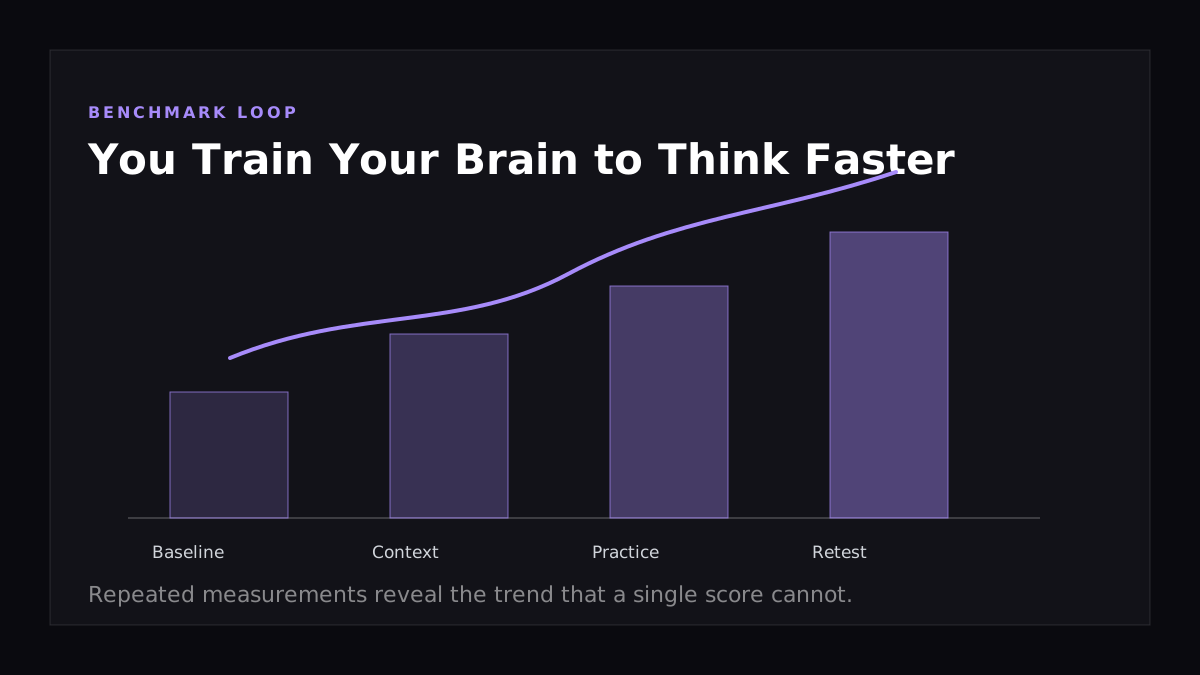
- Treat one score as a snapshot and repeated scores as the real signal.
- Use the Reaction Time as the next measurable step.

How to Use This Guide
Use the article in three passes: scan the quick answer, check the tables or examples that match your situation, then pick one action to test this week. That keeps the article useful even if you only have a few minutes, while still giving you enough detail to come back for deeper context.
What Does "Thinking Faster" Actually Mean?
When people say they want to "think faster," they typically mean one or more of these things:
- Reacting more quickly to events and stimuli
- Processing information more rapidly
- Making decisions with less deliberation time
- Solving problems more efficiently
- Speaking and writing more fluently
Each of these involves different neural systems — and each is trainable to different degrees. But the common underlying factor is cognitive processing speed: the rate at which the brain performs its fundamental operations.
What Is Cognitive Processing Speed?
Cognitive processing speed is a psychometric construct that captures individual differences in how quickly people perform simple cognitive tasks. In the lab, it's typically measured with:
- Reaction time tasks (respond as fast as possible to a stimulus)
- Choice reaction time (respond differently to different stimuli)
- Symbol digit modalities (match symbols to numbers as quickly as possible)
- Simple arithmetic speed (solve basic maths problems quickly)
These tasks all require the brain to move from input to output in minimal time — a core "g factor" component that underlies much of general intelligence.
Processing speed is one of the nine broad cognitive abilities identified in CHC (Cattell-Horn-Carroll) theory, the most widely accepted model of cognitive ability. It's strongly correlated with fluid intelligence, working memory, and academic performance.
The Neuroscience of Processing Speed
What physically determines how fast a brain processes information?
1. White Matter Integrity
The brain's communication network — billions of axons connecting different regions — is wrapped in myelin, a fatty insulating sheath that dramatically speeds electrical conduction. Well-myelinated axons conduct signals at 70–120 metres per second; unmyelinated axons conduct at 0.5–2 m/s.
The integrity and density of white matter — measured with diffusion tensor imaging (DTI) — is one of the strongest neuroimaging predictors of processing speed. People with more coherent, denser white matter tracts are consistently faster on processing speed measures.
Myelin is dynamic — it continues to develop through young adulthood and is sensitive to:
- Exercise: Aerobic exercise upregulates oligodendrocyte production (the cells that make myelin)
- Sleep: Deep sleep supports myelin maintenance and repair
- Omega-3 fatty acids: DHA is a structural component of myelin membranes
- Age: Myelin begins degrading in middle age, contributing to processing speed decline
2. Synaptic Efficiency
Fast thinking requires efficient synaptic transmission — the speed and reliability with which neurons communicate across junctions. Key factors:
Long-term potentiation (LTP): Repeated activation of a neural pathway strengthens its synaptic connections through LTP, making signal transmission faster and more reliable. This is the cellular mechanism of learning and skill acquisition — and directly explains why practice makes reactions faster.
Neurotransmitter systems: Dopamine in the prefrontal cortex supports rapid information updating. Acetylcholine enhances attentional modulation of signal processing. Norepinephrine regulates arousal and alertness. The balance of these systems — heavily influenced by sleep, exercise, nutrition, and stress — directly affects processing speed.
3. Neural Network Efficiency
Fast processing depends not just on raw signal speed but on the efficiency of the networks performing the computation. More efficient networks:
- Use fewer unnecessary neurons (more sparse, targeted activation)
- Have shorter pathway lengths between relevant brain regions
- Show stronger functional connectivity between areas that need to communicate
Expert brains show more efficient, sparse activation patterns than novice brains performing the same task — they accomplish the same computation with less neural work. This is neuroplasticity producing efficiency, not just capacity.
Is Processing Speed Trainable?
Yes — substantially. Here is the evidence across different training approaches:
Reaction Time Training
Directly training stimulus-response speed produces consistent improvements of 20–60ms over 4–8 weeks. The neural mechanism is straightforward: repeated activation of the same neural pathway strengthens it through LTP, and the stimulus-response mapping becomes increasingly automatic (requiring less deliberate processing).
The BrainRivals Reaction Time Test provides exactly this type of training — a clean, repeatable stimulus-response task that directly measures and trains the processing speed pathway.
Working Memory Training
Working memory training (N-back tasks, sequence memory practice) has been shown in multiple studies to improve processing speed on untrained tasks — not just the trained tasks themselves. The mechanism appears to involve strengthening of the prefrontal-parietal network that governs cognitive control, which speeds the allocation of attention and the processing of incoming information.
Action Video Game Training
Action video game training is one of the most robustly demonstrated far-transfer training paradigms. Green & Bavelier (2003) and dozens of subsequent studies have shown that action gamers process visual information faster than non-gamers across a wide variety of tasks. The mechanism involves both faster attentional selection and faster perceptual decision-making — two core components of processing speed.
Aerobic Exercise
Exercise is the most powerful general-purpose cognitive enhancer with consistent evidence across studies. A single bout of moderate exercise (20–30 minutes) produces acute processing speed improvements that last 1–3 hours. Long-term aerobic training produces structural brain changes — increased white matter integrity, enhanced cerebrovascular health, elevated BDNF — that persistently improve processing speed baseline.
Targeted Speed Training (Processing Speed Programs)
Clinical programmes like Posit Science's BrainHQ include processing speed modules specifically designed to train the speed of visual processing. A randomised controlled trial (the ACTIVE study, n = 2,832) found processing speed training reduced at-fault car crashes by 50% and improved everyday functional performance over 10 years in older adults. This is the strongest real-world evidence for processing speed training effectiveness.
Neuroplasticity: The Biological Basis of Getting Faster
Neuroplasticity is the brain's capacity to reorganise its structure and function in response to experience. It operates at multiple levels:
Synaptic plasticity (minutes to hours): Individual synaptic connections strengthen or weaken based on use. Hebb's rule — "neurons that fire together, wire together" — describes how repeated co-activation builds stronger connections.
Structural plasticity (days to months): New dendritic spines form, axons sprout new branches, and unused connections are pruned. This physical remodelling of neural architecture underlies skill acquisition and cognitive improvement.
Myelination (months to years): Heavily used axons are progressively wrapped in thicker myelin sheaths, increasing their conduction velocity. This is one of the mechanisms by which extensive practice produces permanent improvements in processing speed.
Neurogenesis (ongoing): New neurons continue to be born throughout adulthood in the hippocampus (and possibly other regions), integrating into existing circuits and supporting memory and pattern separation.
All of these processes contribute to what happens when you practise a cognitive skill and get faster at it. The improvement is real, measurable, and has a physical substrate in the brain.
What You Cannot Change (The Ceiling)
Neuroplasticity has limits. Some determinants of processing speed are largely fixed:
Genetic baseline: Genetic factors account for approximately 50–80% of the variance in processing speed in adults. Your inherited neural architecture sets the ceiling above which training cannot push you.
Nerve conduction velocity ceiling: Myelinated axons have a biophysical maximum conduction velocity (~120 m/s). Training can improve myelination up to the ceiling for your anatomy, but cannot exceed it.
Age-related structural changes: Some of the processing speed decline with age reflects anatomical changes (myelin degradation, grey matter volume reduction) that lifestyle factors can slow but not prevent entirely.
The practical implication: training cannot turn a person with naturally average processing speed into someone with the fastest human processing speed — but virtually everyone has significant room between their current performance and their biological ceiling. Most people operate well below their potential, and consistent training produces meaningful real-world improvements.
A Complete Strategy to Think Faster
Based on the evidence, here's the most effective combination of approaches:
Immediate wins (days)
- Optimise sleep: One night of full sleep immediately improves processing speed by 20–50ms
- Caffeine: 100–200mg improves reaction time and processing speed within 30–60 minutes
- Hydration: Even mild dehydration impairs processing speed; drink adequate water
- Exercise before cognitive work: A 20-minute brisk walk produces immediate processing speed improvements lasting 1–3 hours
Short-term gains (weeks to months)
- Daily reaction time practice: BrainRivals Reaction Time Test — 10–15 attempts daily
- Working memory training: Sequence Memory and Number Memory tests, progressive difficulty
- Action gaming: 30–60 minutes daily of a fast-paced action game (FPS, rhythm game)
- Aerobic exercise: 3–5 sessions per week, 20–40 minutes each
Long-term transformation (months to years)
- Instrument or language learning: Builds broad neural efficiency through sustained, demanding practice
- Physical fitness as a lifestyle: Ongoing aerobic exercise continuously supports white matter integrity and cerebrovascular health
- Continuous learning: Novel, challenging intellectual engagement maintains synaptic plasticity and delays age-related decline
- Stress management: Chronic stress degrades processing speed through cortisol-mediated prefrontal damage; sustained stress management protects long-term cognitive speed
How to Measure Your Progress
The most direct way to track whether your brain is actually getting faster is to use standardised, repeatable tests. BrainRivals provides several:
- Reaction Time Test: Direct measure of visual processing speed in milliseconds — the cleanest single metric for tracking processing speed improvement
- Sequence Memory Test: Measures working memory speed and capacity
- Number Memory Test: Tracks phonological working memory improvement
Test at consistent times of day (cognitive performance varies by circadian phase — most people peak in mid-morning). Run multiple attempts per session and track your average, not just your best. Compare weekly averages rather than individual scores to see the true trend.
Try It on BrainRivals
Reading about the concept is useful, but a repeatable score is more actionable. Run the Reaction Time, Sequence Memory and Number Memory tests, save your result, then repeat under similar conditions later. The trend matters more than a single best attempt.
Frequently Asked Questions
Is processing speed the same as intelligence?
No, but the two are moderately correlated. Processing speed is one of nine broad cognitive abilities that collectively contribute to general intelligence. It specifically measures how fast simple cognitive operations are performed — not the complexity of reasoning, the breadth of knowledge, or the quality of decision-making. Some highly intelligent people have average processing speed; some fast processors have average general reasoning.
At what age does processing speed peak?
Processing speed peaks in the early-to-mid twenties and declines gradually thereafter. The decline is approximately 1–2ms per year for reaction time, with steeper declines appearing after age 55–60. Importantly, expertise, knowledge, and experience compensate for speed decline in many real-world tasks — which is why experienced professionals often outperform faster but less experienced younger colleagues.
Can children's processing speed be improved?
Yes, and it has important educational implications. Working memory and processing speed training in children has shown improvements in academic performance — particularly mathematics and reading comprehension. Physical exercise at school is one of the most cost-effective interventions, producing improvements in both processing speed and academic outcomes across multiple studies.
Does faster processing speed mean better decisions?
Not necessarily. Decision quality depends on many factors beyond speed: the breadth of information considered, the quality of mental models, emotional regulation, and the ability to tolerate uncertainty. Faster processing speed helps when quick decisions are required (sport, emergencies), but deliberate, slower thinking is often superior for complex, high-stakes decisions. The ability to modulate speed — being fast when necessary and slow when appropriate — is more valuable than raw speed alone.
How reliable are online processing speed tests?
Online tests provide useful, repeatable measurements that track relative change over time. They are less reliable for absolute benchmarking than lab-based clinical tests, due to hardware variability (monitor latency, input device latency) and environmental factors. For tracking personal progress, however, they are highly useful — as long as testing conditions are kept consistent across sessions.