Brain Training Games: Do They Really Work?
Get the short answer first, then use the benchmarks, examples, and BrainRivals practice links to turn the idea into a measurable result.
Quick Answer
This guide turns an abstract idea about brain training into something you can notice, measure, and improve. The fastest way to use it is to read the benchmark first, compare it with your own context, then run a related BrainRivals test under the same conditions for a cleaner before-and-after signal.
Key takeaways
- Start with the practical benchmark, not the trivia.
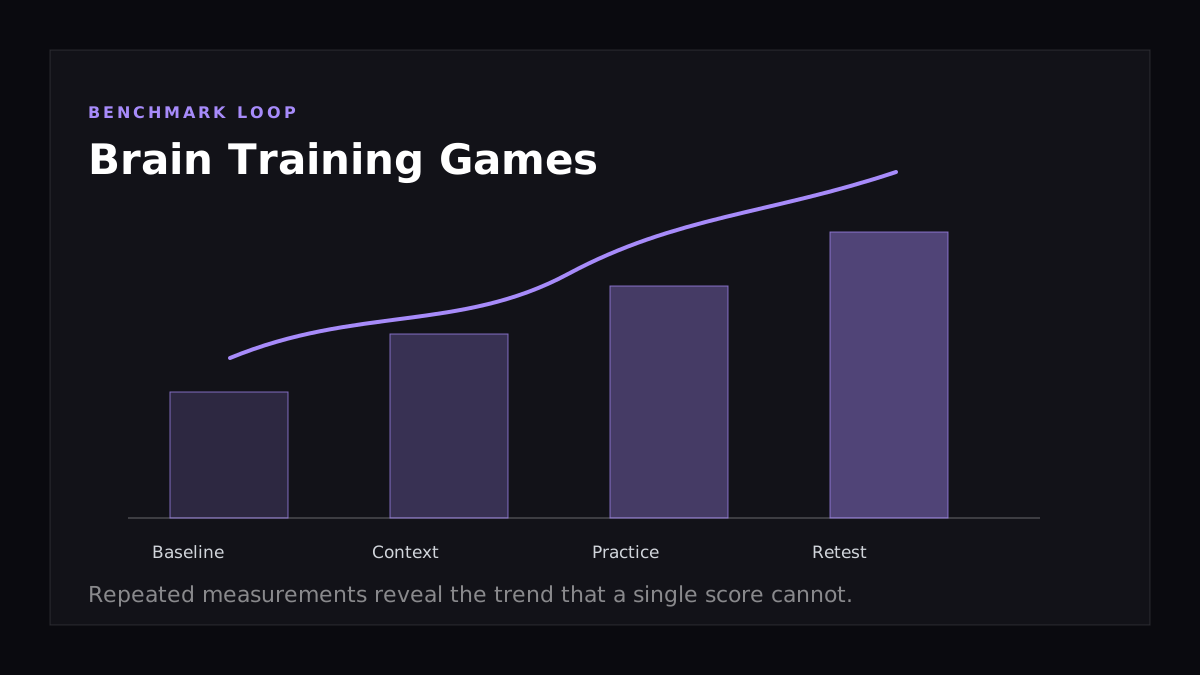
- Treat one score as a snapshot and repeated scores as the real signal.
- Use the Reaction Time as the next measurable step.
How to Use This Guide
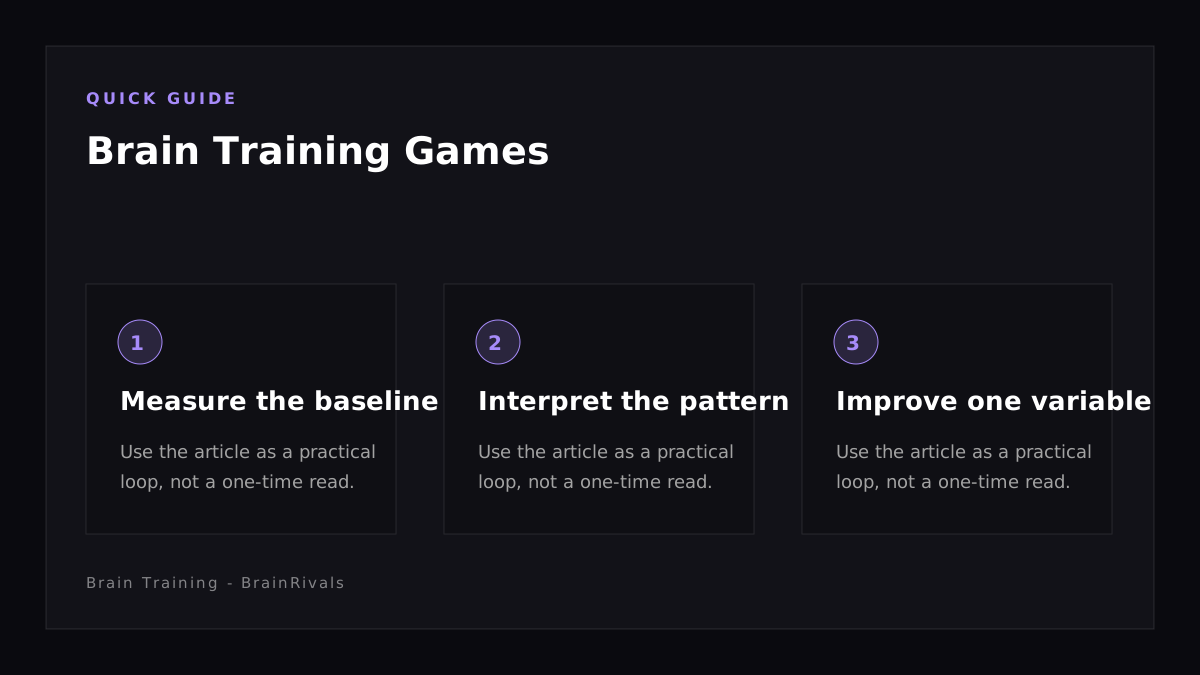
Use the article in three passes: scan the quick answer, check the tables or examples that match your situation, then pick one action to test this week. That keeps the article useful even if you only have a few minutes, while still giving you enough detail to come back for deeper context.
The Brain Training Controversy
In 2014, a letter signed by 75 cognitive neuroscientists warned consumers that brain training apps were making "exaggerated claims" not supported by scientific evidence. Weeks later, a counter-letter signed by 133 different scientists argued that the evidence for cognitive training was being unfairly dismissed.
The debate continues today — but the science has matured considerably. Here's what we actually know.
What "Working" Means in Brain Training Research
Before evaluating the evidence, it's essential to understand what brain training researchers are actually measuring. There are three distinct levels at which a training programme can "work":
Level 1 — Near transfer: Improvement on the trained task itself Level 2 — Far transfer: Improvement on untrained tasks measuring similar cognitive abilities Level 3 — Real-world transfer: Improvement in everyday cognitive function (driving safety, academic performance, work productivity)
Most of the controversy centres on Level 2 and 3 transfer. Level 1 (getting better at the game you practise) is almost guaranteed and not particularly meaningful on its own.
What the Research Says
Strong Evidence: Near Transfer Works
Training on any specific cognitive task produces reliable improvement on that task and closely related tasks. This is not controversial — it's a straightforward application of learning theory.
If you practise the BrainRivals Sequence Memory Test daily, your sequence memory score will improve. If you practise the Reaction Time Test, your reaction time will improve. This is real cognitive improvement — not a trivial finding.
Mixed Evidence: Far Transfer
The critical question is whether training on memory games improves other cognitive abilities (reasoning, academic performance, job performance). The evidence here is genuinely mixed:
Positive findings:
- Jaeggi et al. (2008, PNAS): Dual N-back training improved fluid intelligence in young adults — one of the most-cited positive findings in the field
- Smith et al. (2009): A large commercial brain training programme (Posit Science) improved processing speed in older adults, with benefits persisting at 10-year follow-up
- Green & Bavelier (2003, Nature): Action video game training improved visual attention, spatial resolution, and target discrimination — robust far transfer to untrained visual tasks
Negative findings:
- Owen et al. (2010, Nature): A BBC study (n = 11,430) found that while people improved on trained tasks, performance on untrained cognitive tests did not improve relative to a control group
- Melby-Lervåg et al. (2013, Psychological Bulletin): A meta-analysis of 23 working memory training studies found reliable near transfer but minimal evidence for far transfer to non-trained abilities
The consensus: Most researchers now agree that:
- Task-specific improvement is reliable and real
- Transfer to closely related tasks occurs consistently
- Transfer to broad cognitive abilities (IQ-like gains) is inconsistent across studies and likely smaller than initially claimed
- The type of training matters enormously — active, adaptive, progressive training produces more transfer than passive exercises
Cleaner Evidence: Real-World Applications
The most convincing real-world evidence comes from specific populations and applications:
Older adults and driving safety: A 10-year randomised controlled trial (ACTIVE study) found that older adults trained on visual processing speed tasks had 50% fewer at-fault motor vehicle crashes over 6 years compared to controls. This is a massive, practically important finding.
Academic performance: Chess instruction in schools shows consistent improvements in mathematics and reading in multiple studies across different countries. The transfer is meaningful enough that several national curricula have incorporated chess as a cognitive development tool.
Recovery from brain injury: Cognitive rehabilitation programmes using targeted cognitive training consistently improve functional outcomes in people recovering from stroke, traumatic brain injury, and other acquired brain conditions. This is well-established clinical practice.
Age-related cognitive decline: Several large trials show that cognitive training delays the onset of cognitive decline and reduces dementia risk in older adults with mild cognitive impairment. The effect is real but modest.
The Problem With Commercial Brain Training Claims
The most significant issue is not that brain training doesn't work — it's that many commercial apps make claims far beyond what the evidence supports.
Lumosity was fined $2 million by the US Federal Trade Commission in 2016 for making "unfounded claims" that its games could reduce cognitive impairment from ageing and help prevent Alzheimer's disease. The evidence for these specific claims was not there.
Common misleading claims:
- "Scientifically proven to boost IQ" (evidence is weak and inconsistent)
- "Prevents dementia" (no brain training app has been proven to prevent dementia)
- "Trains 5 core brain functions" (arbitrary categorisations not grounded in neuroscience)
The problem is not brain training itself — it's marketing that overstates what targeted cognitive exercises can achieve.
What BrainRivals Actually Measures
BrainRivals takes a transparent, measurement-focused approach: the platform provides standardised cognitive tests that measure specific, well-defined abilities:
- Reaction Time: Visual stimulus-response speed (milliseconds)
- Sequence Memory: Visuospatial working memory span
- Number Memory: Verbal/phonological working memory span
- Verbal Memory: Recognition memory accuracy
- Visual Memory: Spatial pattern working memory
- Chimp Test: Rapid visuospatial encoding
- Aim Trainer: Hand-eye coordination and targeting speed
- Typing Speed: Typing fluency (WPM)
- Hearing Test: High-frequency auditory threshold
- Visual Acuity: Spatial resolution of vision
These are direct measures of specific cognitive capacities — not vague "brain age" scores. Your percentile on the global leaderboard reflects your genuine performance relative to a real population.
The Honest Bottom Line
| Claim | Verdict |
|---|---|
| "You'll get better at brain training games" | ✅ True — reliably |
| "Brain training improves working memory" | ✅ True — near transfer is consistent |
| "Brain training improves fluid intelligence" | ⚠️ Possible — evidence is mixed |
| "Brain training prevents dementia" | ❌ Not proven |
| "Brain training makes you smarter overall" | ⚠️ Overstated — depends heavily on the training |
| "Reaction time training improves reaction time" | ✅ True — substantial improvements over weeks |
| "Physical exercise improves cognition more than brain games" | ✅ True — robust evidence across all domains |
How to Get the Most From Brain Training
Given the evidence, here's how to use cognitive training most effectively:
1. Use it to measure, not just train Tracking your cognitive performance over time provides genuine insight. Are you improving after changing your sleep habits? After starting exercise? Measurement makes these effects visible.
2. Choose progressive, adaptive training Training that automatically adjusts difficulty to your current level produces more improvement than fixed-difficulty games. BrainRivals tests get progressively harder as you succeed — this progressive challenge drives genuine improvement.
3. Combine with lifestyle habits Exercise, sleep, and nutrition produce larger cognitive improvements than brain training alone. The most effective approach combines all three with targeted cognitive practice.
4. Set realistic expectations Expect to get noticeably better at the specific skills you train. Expect meaningful improvements in closely related abilities. Don't expect to radically increase your IQ or prevent neurological disease.
5. Make it regular and consistent 15–20 minutes of daily training is more effective than longer occasional sessions. Cognitive skills develop through consistent repetition, not marathon sessions.
Try It on BrainRivals
Reading about the concept is useful, but a repeatable score is more actionable. Run the Reaction Time, Sequence Memory and Verbal Memory tests, save your result, then repeat under similar conditions later. The trend matters more than a single best attempt.
Frequently Asked Questions
Are free brain training sites as good as paid apps?
The quality of the cognitive science behind the tasks matters more than price. Many free platforms (including BrainRivals) provide well-validated tests of specific cognitive abilities. Paying for an app doesn't guarantee better science — evaluate the specific tasks and what they actually measure.
Is there a best age to start brain training?
Cognitive training is beneficial across the entire lifespan, but serves different purposes at different ages. Children benefit most from rich learning environments and physical activity. Working-age adults benefit from maintaining and optimising performance. Older adults benefit most from preservation of function and potentially delaying decline.
How many days per week should I do brain training?
Most research protocols use 3–5 sessions per week, each 15–30 minutes. Daily practice is feasible and may produce slightly faster improvement, but rest days are also valuable — sleep consolidates the learning from training sessions.
Can brain training help with ADHD?
Some cognitive training programmes have shown benefits for specific ADHD symptoms — particularly working memory deficits and attention control. However, the effect sizes are modest and brain training is not a replacement for evidence-based ADHD treatments (medication, behavioural therapy). It may be a useful adjunct.
What is the most evidence-backed brain training task?
The dual N-back task has the most research behind it for broad cognitive transfer. For specific abilities, the most evidence-backed approaches are: working memory training for working memory improvement, action video game training for visual attention and reaction time, and physical exercise for broad cognitive enhancement across all domains.