The Science of Memory: Why We Forget Things
Get the short answer first, then use the benchmarks, examples, and BrainRivals practice links to turn the idea into a measurable result.
Quick Answer
This guide turns an abstract idea about memory into something you can notice, measure, and improve. The fastest way to use it is to read the benchmark first, compare it with your own context, then run a related BrainRivals test under the same conditions for a cleaner before-and-after signal.
Key takeaways
- Start with the practical benchmark, not the trivia.
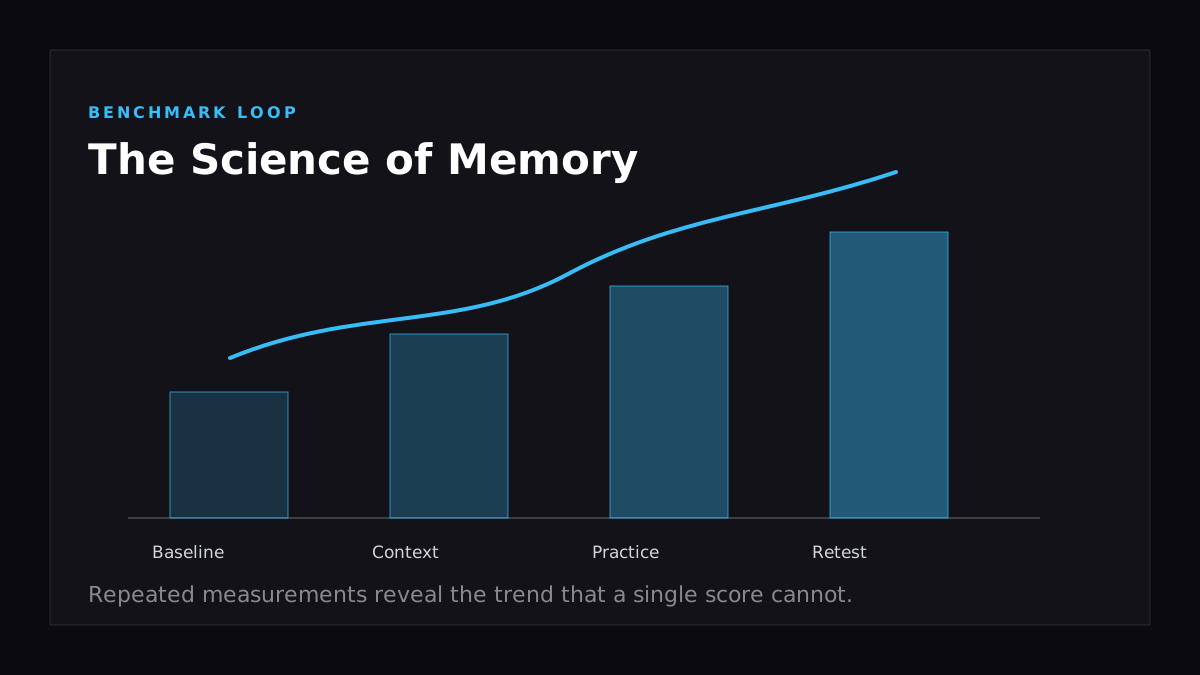
- Treat one score as a snapshot and repeated scores as the real signal.
- Use the Sequence Memory as the next measurable step.

How to Use This Guide
Use the article in three passes: scan the quick answer, check the tables or examples that match your situation, then pick one action to test this week. That keeps the article useful even if you only have a few minutes, while still giving you enough detail to come back for deeper context.
How Memory Works: The Big Picture
Human memory is not a single system — it's a collection of distinct but interacting systems, each with its own neural substrates, capacity limits, and vulnerability to forgetting. Understanding the architecture helps explain why you remember some things effortlessly and forget others almost immediately.
The major memory systems are:
| Memory System | Duration | Capacity | Example |
|---|---|---|---|
| Sensory memory | < 1 second | Very high | Afterimage when looking at a light |
| Working memory | Seconds | Very limited (~4 chunks) | Remembering a phone number while dialling |
| Long-term memory (declarative) | Years to lifetime | Virtually unlimited | Your childhood home's address |
| Long-term memory (procedural) | Years to lifetime | Large | How to ride a bicycle |
Most everyday forgetting occurs at the boundary between working memory and long-term memory — information that was briefly held but never properly encoded into durable storage.
Sensory Memory: The First Filter
Every moment, your senses are flooded with far more information than the brain can process. Sensory memory provides a brief buffer — less than one second — in which sensory information is held in a near-raw form before most of it is discarded.
Iconic memory (visual): Lasts approximately 0.25–0.5 seconds. This is what allows you to perceive smooth motion in films (sequential static frames appearing continuous) and what the Chimp Test exploits — the numbers are briefly available as a visual icon before they fade.
Echoic memory (auditory): Lasts approximately 2–4 seconds — longer than iconic memory, which is why you can "replay" the last few words of a conversation you weren't paying attention to.
Most sensory information is discarded at this stage. Only information that receives attentional selection is passed on to working memory.
Working Memory: The Desk of the Mind
Working memory is the cognitive workspace where you actively hold and manipulate a small amount of information over seconds. It's what you use when doing mental arithmetic, following multi-step instructions, or holding the beginning of a sentence in mind while you read the end.
Alan Baddeley's influential model describes working memory as having three key components:
The phonological loop stores and rehearses verbal and numerical information through inner speech. This is what holds a phone number in mind while you walk to the phone. Capacity: approximately 7 ± 2 items (Miller, 1956), reducible to 4 ± 1 meaningful chunks (Cowan, 2001).
The visuospatial sketchpad stores and manipulates visual and spatial information — mental images, object locations, spatial relationships. This is what you use when mentally rotating a shape or remembering where something was placed. Tested by the Visual Memory and Sequence Memory tests.
The central executive is the attentional controller — it directs focus, switches between tasks, and coordinates the other systems. It doesn't store information itself but governs how the working memory system operates as a whole.
The episodic buffer (added in 2000) integrates information from the phonological loop, visuospatial sketchpad, and long-term memory into coherent, multimodal episodes.
Why Working Memory Forgets So Fast
Working memory is fundamentally temporary — without active maintenance (rehearsal), information typically fades within 15–30 seconds. Two mechanisms drive this:
Decay: The neural activity sustaining a working memory representation simply fades over time unless refreshed through rehearsal.
Interference: New incoming information displaces older representations. This is why you forget the beginning of a complex sentence by the time you reach the end, if the sentence is sufficiently long.
Long-Term Memory: The Brain's Archive
Long-term memory is the brain's relatively permanent storage system. It has virtually unlimited capacity and can last a lifetime. Unlike working memory, long-term memory is stored as structural changes in neural connections — not as ongoing electrical activity — making it far more durable.
Declarative Memory: "Knowing That"
Declarative (explicit) memory is memory for facts and events that can be consciously recalled:
Episodic memory stores specific personal experiences with their temporal and contextual details: "I ate sushi last Tuesday in that restaurant near the office." The hippocampus is critical for forming new episodic memories.
Semantic memory stores general world knowledge independent of personal context: "Paris is the capital of France." "Water boils at 100°C." Semantic memory is more distributed across the cortex and is more resistant to hippocampal damage than episodic memory.
Non-Declarative Memory: "Knowing How"
Non-declarative (implicit) memory operates outside conscious awareness:
Procedural memory stores motor and cognitive skills — riding a bike, touch typing, driving a car. Once learned, these skills become automatic and don't require working memory resources. Procedural memory is stored in the basal ganglia and cerebellum and is notably resistant to many amnesic conditions (patients who cannot form new declarative memories can still learn new motor skills).
Priming is a facilitation effect where exposure to one stimulus influences the processing of a later related stimulus — usually without conscious awareness.
Conditioned responses are automatic emotional or physiological reactions to previously paired stimuli — the neural basis of both beneficial habits and phobias.
How Memories Are Formed: Encoding and Consolidation
Forgetting begins before memories are even formed. The quality of encoding — how deeply and distinctively a memory is processed at the time of learning — determines its durability.
Levels of processing (Craik & Lockhart, 1972): Information processed at a deep (semantic, meaningful) level is remembered far better than information processed at a shallow (surface, perceptual) level. Reading a word and thinking about its meaning produces a much more durable memory trace than reading a word and noting whether it contains the letter "e."
Consolidation: Newly encoded memories are initially unstable and must be consolidated — converted from temporary, labile traces into stable, long-term representations. This happens in two phases:
- Synaptic consolidation (minutes to hours): Protein synthesis at the synapse strengthens the neural connections representing the memory.
- Systems consolidation (days to years): The hippocampus gradually transfers memory representations to distributed cortical storage, becoming less necessary for retrieval over time (the standard model of memory consolidation).
Sleep is critical for consolidation: During slow-wave sleep, the hippocampus replays recent memories to the cortex, strengthening their storage. During REM sleep, emotional memories are processed and integrated. This is why "sleeping on it" genuinely improves memory — and why sleep deprivation dramatically impairs both encoding and consolidation.
Why We Forget: The Main Mechanisms
Forgetting is not a system failure — it's an adaptive feature. A brain that remembered everything with equal fidelity would be overwhelmed by irrelevant detail and unable to extract patterns or make generalisations. Selective forgetting is cognitively functional.
1. Encoding Failure
The most common "forgetting" isn't forgetting at all — the information was never properly encoded in the first place. When you "forget" where you put your keys, you probably didn't attend to where you put them at the time. No encoding → no memory to forget.
2. Decay
Memory traces weaken over time without rehearsal or retrieval. Hermann Ebbinghaus's classic 1885 experiments produced the forgetting curve — a mathematical description of how rapidly newly learned information is forgotten without reinforcement. Within 24 hours, approximately 70% of material is forgotten without review. Spaced repetition directly counters decay by reinforcing memories at optimal intervals.
3. Interference
New information interferes with older memories (retroactive interference), and old memories interfere with new learning (proactive interference). This is why learning similar material in sequence is harder than learning dissimilar material, and why sleep between learning sessions (which reduces new interference) benefits retention.
4. Retrieval Failure
Some memories exist in long-term storage but cannot be retrieved — the information is there, but the retrieval cue is insufficient to access it. This produces the "tip of the tongue" state: knowing you know something but being unable to retrieve it. Providing the right cue (the first letter of a forgotten name, the context of when information was learned) can unlock the memory instantly.
5. Motivated Forgetting
The brain can actively suppress unwanted memories — a phenomenon studied by Anderson & Green (2001) using fMRI. When people tried to suppress memories, the prefrontal cortex inhibited hippocampal activity, reducing later recall. This "motivated forgetting" mechanism may underlie the psychological concept of repression, though its role in clinical amnesia remains debated.
The Role of Emotion in Memory
Emotional events are remembered more vividly and durably than neutral events — a phenomenon called emotional memory enhancement. The amygdala (the brain's emotion processing centre) modulates hippocampal encoding: when an event is emotionally significant, the amygdala signals the hippocampus to encode it more strongly.
This is why you vividly remember where you were during major life events, but can't recall what you had for lunch two Tuesdays ago. The brain prioritises emotionally significant information because it is more likely to be relevant to future survival and decision-making.
How Memory Tests Measure Cognitive Capacity
BrainRivals' memory tests each target a specific sub-system of memory:
| Test | Memory System Tested | Key Mechanism |
|---|---|---|
| Number Memory | Phonological loop (working memory) | Digit span — verbal rehearsal capacity |
| Sequence Memory | Visuospatial sketchpad (working memory) | Sequential spatial memory |
| Visual Memory | Visuospatial sketchpad (working memory) | Pattern encoding and recall |
| Verbal Memory | Episodic + semantic long-term memory | Recognition memory accuracy |
| Chimp Test | Rapid visuospatial encoding | Ultra-fast spatial snapshot |
Testing across multiple systems provides a more complete picture of your memory profile than any single test can offer. A person might have excellent phonological working memory but average visuospatial memory — a pattern that would not be revealed by a single digit span test alone.
How to Improve Memory Encoding and Reduce Forgetting
Spaced repetition
Review material at increasing intervals (1 day, 3 days, 7 days, 21 days). This exploits the spacing effect — the most robust finding in memory research — to consolidate information before it fully decays.
Elaborative encoding
Connect new information to existing knowledge. Ask "why?" and "how does this relate to what I already know?" This deep processing creates a richer memory trace with more retrieval routes.
Retrieval practice
Testing yourself on material (rather than re-reading it) dramatically improves long-term retention — the testing effect. Active recall during learning is far more effective than passive review.
Sleep
Consistently getting 7–9 hours of sleep provides the consolidation window that converts daily learning into durable long-term memories. Studying before sleep (not immediately before — allow 30–60 minutes for wind-down) leverages the sleep consolidation window maximally.
Reduce interference
Space out the learning of similar material. Don't study two similar languages in the same session. Don't practise two similar musical pieces back-to-back without intervening different material.
Try It on BrainRivals
Reading about the concept is useful, but a repeatable score is more actionable. Run the Sequence Memory, Number Memory and Verbal Memory tests, save your result, then repeat under similar conditions later. The trend matters more than a single best attempt.
Frequently Asked Questions
Why do I remember old memories better than recent ones?
Old, frequently retrieved memories have been consolidated and reinforced many times — they are stored durably in distributed cortical networks. Recent memories may still be in the process of hippocampal-to-cortical transfer and have had fewer retrieval opportunities. This is why the past can feel vivid while yesterday feels blurry.
Is photographic memory real?
True eidetic memory — the ability to perfectly recall images in full detail, as if reading a photograph — is extremely rare and possibly doesn't exist in adults. What people describe as "photographic memory" is usually either a very strong visuospatial memory or a highly trained mnemonic skill.
Can you improve long-term memory?
Yes, through better encoding strategies (elaboration, spacing, retrieval practice) and lifestyle factors (sleep, exercise, stress management). You cannot increase the maximum capacity of long-term memory — it's effectively unlimited — but you can dramatically improve the proportion of learned material that is retained.
Why do we remember dreams so briefly after waking?
Dreams are generated during REM sleep from hippocampal and cortical activity, but the neurochemical environment during sleep (low norepinephrine, low acetylcholine in some phases) is not conducive to the encoding of these experiences into long-term memory. Within minutes of waking, most dream content decays from working memory without ever being consolidated.
What is the difference between forgetting and not paying attention?
This is one of the most important distinctions in memory research. If you don't attend to information (you were distracted, on autopilot, thinking about something else), it was never encoded — so "forgetting" it isn't really forgetting in the technical sense. Most everyday memory failures are encoding failures, not retrieval failures. The practical implication: the most effective memory improvement strategy is not better retrieval, but better attention and encoding at the time of learning.