Number Memory Test: Digit Span, Average Scores & Memory Techniques
Get the short answer first, then use the benchmarks, examples, and BrainRivals practice links to turn the idea into a measurable result.
Quick Answer
This guide turns an abstract idea about memory into something you can notice, measure, and improve. The fastest way to use it is to read the benchmark first, compare it with your own context, then run a related BrainRivals test under the same conditions for a cleaner before-and-after signal.
Key takeaways
- Start with the practical benchmark, not the trivia.
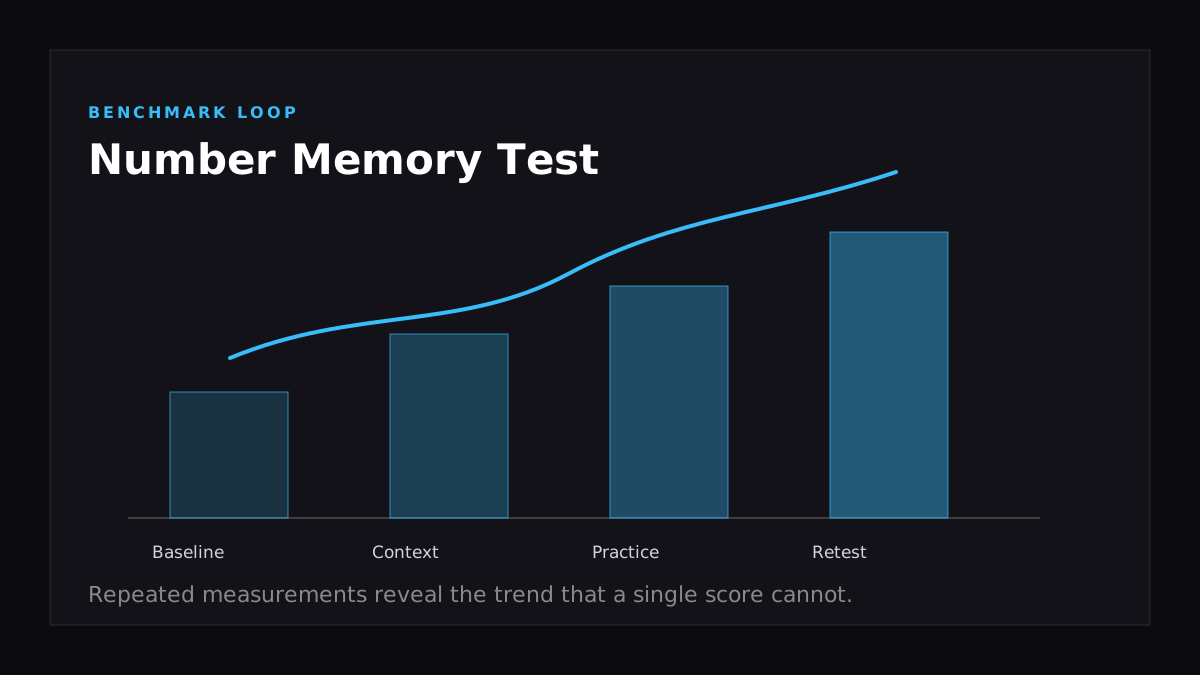
- Treat one score as a snapshot and repeated scores as the real signal.
- Use the Number Memory as the next measurable step.

How to Use This Guide
Use the article in three passes: scan the quick answer, check the tables or examples that match your situation, then pick one action to test this week. That keeps the article useful even if you only have a few minutes, while still giving you enough detail to come back for deeper context.
What Is the Number Memory Test?
The number memory test measures your digit span — the maximum length of a number sequence you can accurately recall immediately after seeing it. In the BrainRivals test, a number is displayed on screen for a brief moment, then hidden. You must type it back exactly as shown. Each successful round adds one more digit to the sequence.
It's one of the oldest and most widely used cognitive tests in psychology. The digit span subtest has appeared in the Wechsler Adult Intelligence Scale (WAIS) since 1939 and remains a standard component of neuropsychological assessment worldwide.
What Does the Number Memory Test Measure?
The test primarily assesses the phonological loop — the component of working memory responsible for temporarily holding and rehearsing verbal and numerical information. When you see a number and silently repeat it to yourself, you're using this system.
Three cognitive processes are involved:
1. Encoding speed: How quickly your brain registers and stores each digit as it appears.
2. Rehearsal efficiency: The phonological loop has a time limit — items decay unless actively rehearsed. Faster inner speech allows more digits to be refreshed before they fade.
3. Chunking ability: Grouping digits into meaningful clusters (e.g., reading "07911" as a UK mobile prefix rather than five separate digits) dramatically extends effective capacity beyond raw working memory limits.
Average Number Memory Scores
| Performance Level | Digits Recalled | BrainRivals Tier |
|---|---|---|
| Elite | 14+ digits | 🔴 Elite |
| Above average | 12–13 digits | 💎 Diamond |
| Average | 9–11 digits | 🥇 Gold |
| Below average | 7–8 digits | 🥈 Silver |
| Beginner | 1–6 digits | 🥉 Bronze |
The global average on BrainRivals is 9 digits. This is slightly higher than the classical Miller (1956) average of 7 ± 2, reflecting both the effect of chunking strategies that players naturally adopt and the selection bias of people motivated to test their memory.
In clinical settings, a forward digit span of 5–8 is considered normal for adults. Scores below 5 can indicate working memory impairment and may warrant further assessment.
Digit Span by Age
Like other working memory tasks, digit span develops through childhood, peaks in early adulthood, and gradually declines with age:
| Age Group | Average Digit Span |
|---|---|
| Age 7 | 4–5 digits |
| Age 10 | 5–6 digits |
| Age 14 | 6–7 digits |
| Adults (18–35) | 7–9 digits |
| Adults (35–55) | 7–8 digits |
| Older adults (55+) | 6–7 digits |
Children's digit spans increase roughly one digit every two years through middle childhood, reflecting the maturation of phonological loop capacity and rehearsal speed.
Forward vs. Backward Digit Span
The BrainRivals number memory test uses forward digit span — remembering numbers in the order they were presented. Neuropsychologists also use backward digit span, where you must recall the sequence in reverse order.
Backward digit span is consistently harder (typically 1–2 digits shorter) because it requires active mental manipulation rather than passive repetition. It's a stronger measure of executive function and working memory manipulation, not just storage.
| Task | Typical Adult Score | Cognitive Demand |
|---|---|---|
| Forward digit span | 7–9 digits | Storage only |
| Backward digit span | 5–7 digits | Storage + manipulation |
Why Number Memory Matters
You might think digit span is an obscure lab skill, but it underpins a surprising range of real-world tasks:
Mental arithmetic: Performing multi-step calculations in your head requires holding intermediate results in working memory while continuing to compute.
Phone numbers and codes: Before smartphones, memorising 10+ digit phone numbers was a daily requirement. Even now, PIN codes, authentication codes, and account numbers appear regularly.
Language processing: Reading fluency and listening comprehension both depend on holding recently processed words in memory while integrating them with new input.
Learning and instruction-following: Students who struggle to remember multi-step instructions often have lower digit spans — the two are directly linked.
Professional contexts: Air traffic controllers, surgeons relaying measurements, and financial traders processing numbers all depend on robust digit span capacity under pressure.
The Science of Chunking: Going Beyond 7
The most powerful technique for extending digit span beyond average is chunking — grouping individual digits into larger, meaningful units.
A random 12-digit number like 381947562034 seems impossibly long. But grouped as 381 | 947 | 562 | 034, it becomes four 3-digit chunks — and most people can hold 4–5 chunks in working memory even when each chunk contains 3 items.
Why chunking works: Working memory capacity is better described in terms of chunks than individual items. By compressing information into meaningful groups, you effectively multiply the raw capacity of your phonological loop.
Expert mnemonists take this further with techniques like the Major System — a mnemonic code that converts numbers into consonant sounds, which are then combined into vivid words or images. The number 382 becomes "m-f-n" → "muffin." A sequence of 20 digits becomes a bizarre story about 7 objects — far easier to remember than 20 individual numbers.
7 Techniques to Improve Your Digit Span
1. Chunking
Group digits into clusters of 3–4. Read 1-8-4-7-2-9 as 184 + 729 — two chunks rather than six items. This alone can push most people from 7 to 10+ digits.
2. Rhythmic encoding
Apply a rhythmic pattern to the number, like a phone number rhythm (3 digits — pause — 3 digits — pause — 4 digits). Rhythm adds temporal structure that aids recall.
3. Visualisation
Turn numbers into visual images. 7 might be a boomerang; 8 a snowman; 3 a pair of lips. Chain the images into a story. Bizarre, vivid imagery is retained far better than abstract digits.
4. The Major System
Learn the Major System mnemonic code, which assigns consonant sounds to digits 0–9. Numbers become words, words become images, images become stories. With practice, this enables recall of 20–30+ digit sequences.
5. Spaced repetition practice
Rather than massing practice into one long session, spread it across multiple short sessions. Spaced repetition leverages the spacing effect — one of the most robust findings in memory research — to consolidate digit span improvements more durably.
6. Reduce anxiety
Test anxiety directly impairs working memory by consuming phonological loop resources with intrusive thoughts. Practise in a relaxed, low-stakes setting to establish a true baseline, then gradually introduce more pressure.
7. Improve sleep quality
Sleep is critical for memory consolidation. Short-changing sleep by even 90 minutes significantly reduces working memory capacity the following day. Prioritising 7–9 hours consistently is one of the most effective memory interventions available.
Number Memory vs. Other Memory Tests
| Test | Memory Type | Key Difference |
|---|---|---|
| Number Memory | Verbal/phonological working memory | Digits, sequential order |
| Sequence Memory | Visuospatial working memory | Spatial positions, sequential order |
| Visual Memory | Spatial pattern memory | Grid locations, no sequence |
| Verbal Memory | Recognition memory | Words seen vs. not seen |
| Chimp Test | Rapid visual capture | Numbers vanish immediately |
Number memory is the most "phonological" of the memory tests — it most directly exercises the inner speech rehearsal loop. People who are strong verbal processors (readers, writers, language learners) often perform well here relative to visual memory tasks.
How to Take the BrainRivals Number Memory Test
Go to the Number Memory Test. A number appears on screen for a brief time, then disappears. Type it back exactly. Each correct answer adds one more digit.
Tips for your first session:
- Read the number aloud in your head as it appears — this activates the phonological loop
- Group the digits into chunks immediately while the number is still visible
- Type confidently — hesitation doesn't help and uses up time you could spend rehearsing
- Don't give up after one failure — take three attempts and use the best as your benchmark
Try It on BrainRivals
Reading about the concept is useful, but a repeatable score is more actionable. Run the Number Memory, Sequence Memory and Verbal Memory tests, save your result, then repeat under similar conditions later. The trend matters more than a single best attempt.
Frequently Asked Questions
What is considered a good number memory score?
Recalling 9+ digits puts you in the Gold tier (average) on BrainRivals. Diamond tier (12–13 digits) is genuinely impressive and reflects strong working memory or effective mnemonic use. Elite (14+ digits) is exceptional and typically involves dedicated memory training techniques.
Is digit span related to intelligence?
Yes, moderately. Digit span correlates with general fluid intelligence (r ≈ 0.35–0.45 in most studies) and with academic performance. However, it measures one specific component of cognition — phonological working memory — and many highly intelligent people have average digit spans.
Can memory training increase digit span?
Direct training reliably improves performance on the trained task. Learning mnemonic systems like chunking or the Major System can produce dramatic increases — people who invest in these techniques routinely reach 15–20+ digits. General working memory training shows more modest, less consistent transfer to untrained tasks.
Why do I forget the middle digits most often?
This is the serial position effect — specifically the absence of a recency effect for items in the middle of a list. Items at the start (primacy effect) benefit from extra rehearsal; items at the end (recency effect) are still in short-term storage. Middle items receive neither advantage. Chunking helps by distributing recall load more evenly.
Does being good at maths help digit span?
Somewhat. People who work regularly with numbers tend to have stronger digit span, likely because they've naturally developed chunking strategies over time. However, digit span is primarily a working memory skill — not mathematical reasoning — so you don't need to be good at maths to achieve an excellent score.