7 Habits That Improve Your Brain Speed and Mental Agility
Get the short answer first, then use the benchmarks, examples, and BrainRivals practice links to turn the idea into a measurable result.

Quick Answer
This guide turns an abstract idea about brain training into something you can notice, measure, and improve. The fastest way to use it is to read the benchmark first, compare it with your own context, then run a related BrainRivals test under the same conditions for a cleaner before-and-after signal.
Key takeaways
- Start with the practical benchmark, not the trivia.
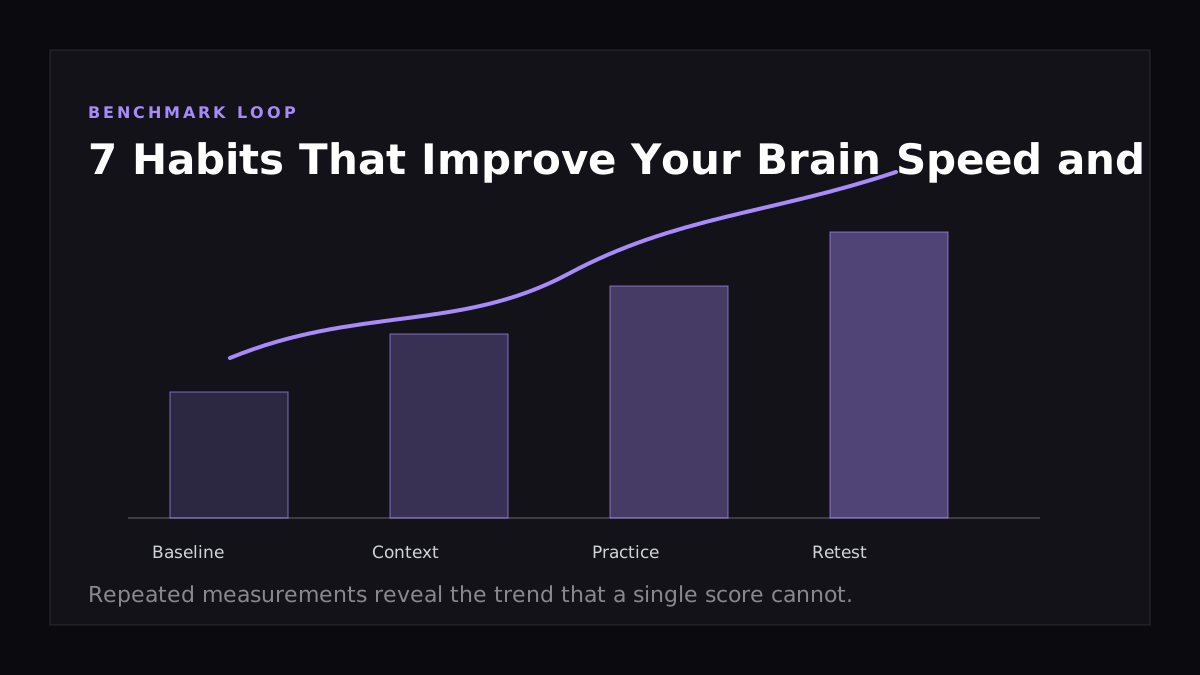
- Treat one score as a snapshot and repeated scores as the real signal.
- Use the Reaction Time as the next measurable step.
How to Use This Guide
Use the article in three passes: scan the quick answer, check the tables or examples that match your situation, then pick one action to test this week. That keeps the article useful even if you only have a few minutes, while still giving you enough detail to come back for deeper context.
Can You Actually Improve How Fast Your Brain Works?
Yes — and the evidence is more compelling than most people realise. While your brain's fundamental architecture is set by genetics, the speed and efficiency with which it processes information is highly malleable throughout life. Neuroscientists call this capacity neuroplasticity — the brain's ability to reorganise its connections in response to experience, behaviour, and environment.
The habits below don't just make you feel sharper — they produce measurable changes in neural efficiency, processing speed, and cognitive output that show up in standardised tests.
Habit 1: Protect Your Sleep (The Single Biggest Lever)
If you do nothing else from this list, protect your sleep. No other single habit has a larger impact on brain speed.
What the research shows:
- A single night of 6 hours of sleep (vs. 8 hours) increases reaction time by 20–50ms — the equivalent of dropping an entire tier on BrainRivals
- After 17 hours of wakefulness, cognitive impairment matches a blood alcohol content of 0.05%
- Working memory capacity falls 20–30% after one night of poor sleep
- The prefrontal cortex — responsible for decision-making and processing speed — is the first brain region to show functional impairment under sleep deprivation
What happens during sleep: During deep sleep (slow-wave sleep), the brain clears metabolic waste products including beta-amyloid (linked to Alzheimer's) through the glymphatic system. During REM sleep, the brain consolidates the day's learning, strengthens neural connections, and prunes inefficient synapses — literally optimising itself for the next day's performance.
How to implement:
- Aim for 7–9 hours per night consistently (not just on weekends)
- Keep your sleep schedule regular — inconsistent timing disrupts circadian rhythms even when total hours are adequate
- Sleep in a cool, dark, quiet room (18–20°C is optimal for most adults)
- Avoid screens for 45 minutes before bed and caffeine after 2pm
Habit 2: Exercise Aerobically, Regularly
Aerobic exercise is the most extensively researched cognitive enhancer available — and it's free.
Acute effects (within 20 minutes of exercise):
- Reaction time improves by 10–25ms
- Working memory capacity increases
- Sustained attention improves for 1–3 hours
- Executive function (planning, switching, inhibition) peaks
Long-term structural effects:
- Increased hippocampal volume (up to 2% over 1 year — reversing age-related shrinkage)
- Enhanced prefrontal cortex connectivity and white matter integrity
- Improved cerebrovascular health — more efficient blood and oxygen delivery to all brain regions
- Elevated BDNF (brain-derived neurotrophic factor) — the brain's primary growth factor
A landmark study (Erickson et al., 2011, PNAS) found that older adults who walked 40 minutes three times per week for a year increased hippocampal volume and significantly improved spatial memory compared to a stretching control group.
How to implement:
- 150 minutes per week of moderate aerobic activity (brisk walking, jogging, cycling, swimming)
- Even a 20-minute walk before cognitively demanding work produces acute improvements
- Higher intensity (HIIT) may produce slightly larger BDNF release than steady-state
- Consistency matters more than intensity — three 30-minute sessions outperform one 90-minute session
Habit 3: Do Daily Cognitive Training
Targeted cognitive training — practising specific mental tasks — directly strengthens the neural circuits involved. Like physical fitness, the effect is specific to the trained pathway but also shows meaningful transfer to related tasks.
What works:
- Reaction time training: Daily use of the BrainRivals Reaction Time Test builds neural efficiency in stimulus-response pathways. Most people improve 20–40ms over 4–6 weeks of daily practice
- Working memory training: Sequence memory, number memory, and N-back tasks strengthen the prefrontal-parietal network supporting cognitive control
- Dual-task training: Practising two cognitive tasks simultaneously (like the Chimp Test) builds cognitive flexibility and attentional control
The key principle: Progressive difficulty. Just as physical strength training requires progressively heavier weights, cognitive training requires progressively harder tasks. Staying at a comfortable level produces minimal further gains.
How to implement:
- 15–20 minutes of targeted cognitive training daily, 5 days per week
- Rotate between different cognitive domains across sessions (reaction, memory, attention)
- Track scores over time — measurable progress is both motivating and informative
Habit 4: Eat for Your Brain
Diet profoundly affects neurotransmitter availability, cerebrovascular health, and inflammation — all of which directly influence brain processing speed.
Key nutritional factors:
Omega-3 fatty acids (DHA/EPA): Critical for maintaining myelin sheath integrity and cell membrane fluidity. Low DHA is associated with slower neural conduction and cognitive decline. Sources: oily fish (salmon, mackerel, sardines) 2–3 times per week, or omega-3 supplements.
Antioxidants: Oxidative stress impairs neural function. Foods rich in antioxidants (blueberries, dark chocolate, green tea, leafy greens) reduce neuroinflammation and support cognitive performance. The MIND diet — specifically designed for brain health — combines Mediterranean and DASH diet elements with particular emphasis on berries, leafy greens, and fish.
Glucose regulation: The brain is uniquely dependent on glucose. Spikes and crashes in blood sugar produce corresponding spikes and crashes in cognitive performance. A low-glycaemic diet with adequate complex carbohydrates (oats, legumes, vegetables) maintains more stable cognitive performance throughout the day.
Hydration: Even mild dehydration (1–2% of body weight) measurably impairs reaction time, attention, and short-term memory. Drinking adequate water (approximately 2–3 litres per day for most adults) is a basic cognitive prerequisite.
Caffeine: At moderate doses (100–200mg — one or two cups of coffee), caffeine reliably improves reaction time (−10–30ms), sustained attention, and working memory. The effect peaks 30–60 minutes after consumption and lasts 4–6 hours.
How to implement:
- Prioritise oily fish, berries, leafy greens, nuts, and olive oil
- Minimise ultra-processed foods, excessive sugar, and alcohol
- Stay hydrated throughout the day
- Use caffeine strategically — one cup before cognitive work, not habitually throughout the day
Habit 5: Practise Mindfulness Meditation
Mindfulness meditation — sustained, non-judgmental attention to present-moment experience — directly trains the attentional control systems that govern cognitive speed and efficiency.
What the research shows:
- Regular meditators show 15–30ms faster reaction times than matched non-meditators (Lao et al., 2016)
- 8 weeks of mindfulness practice produces measurable increases in grey matter density in the prefrontal cortex and hippocampus
- Working memory capacity improves after mindfulness training
- Mind-wandering — a major source of cognitive inefficiency — decreases substantially
How it works: Mindfulness training strengthens the anterior cingulate cortex (ACC) and dorsolateral prefrontal cortex — the brain regions responsible for sustaining attention, monitoring performance, and suppressing distraction. A stronger attentional control system means more cognitive resources are available for the task at hand, and less is wasted on irrelevant thoughts.
How to implement:
- 10–20 minutes of focused attention practice daily
- Sit comfortably, close your eyes, and focus on the sensations of breathing
- When your attention wanders (it will), gently return it to the breath without judgement
- Use guided apps (Headspace, Waking Up, Insight Timer) for structure, especially early on
- Improvements in cognitive measures typically appear after 4–8 weeks
Habit 6: Challenge Yourself with New Learning
The brain strengthens connections that are used and prunes those that aren't — a principle known as synaptic plasticity. Learning genuinely new skills (not just practising existing ones) forces the formation of entirely new neural pathways, broadly enhancing cognitive flexibility.
High-value learning activities:
- Musical instrument: Simultaneously engages fine motor control, auditory processing, pattern recognition, and working memory — one of the most cognitively demanding skills available
- New language: Language learning is one of the most studied forms of broad cognitive enhancement, improving executive function, cognitive switching, and processing speed
- Complex physical skills (dance, martial arts, gymnastics): Combine motor learning, spatial processing, and pattern recognition in demanding ways that transfer broadly to cognitive function
- Strategy games (chess, Go): Develop planning, pattern recognition, and working memory in an endlessly challenging domain
The key principle: Novelty and challenge. Doing familiar tasks on autopilot produces no new neural growth. Learning something genuinely difficult — something where you make mistakes and must actively correct them — drives neuroplasticity.
How to implement:
- Dedicate 30–60 minutes daily to a genuinely challenging skill you're developing
- Embrace making mistakes — they signal that you're in the productive learning zone
- Seek progressive challenge — increase difficulty as skills improve
Habit 7: Manage Stress Actively
Chronic stress is one of the most powerful destroyers of cognitive performance. The stress hormone cortisol, at persistently elevated levels, damages the hippocampus, impairs prefrontal function, and significantly slows cognitive processing.
What chronic stress does to brain speed:
- Impairs working memory (cortisol disrupts prefrontal dopamine signalling)
- Reduces the density of synaptic connections in the prefrontal cortex
- Shrinks hippocampal volume over years of exposure
- Reduces neural plasticity — making it harder to learn and adapt
Acute stress (brief, manageable challenges) is different — it can temporarily sharpen focus and speed reactions by releasing adrenaline and activating the sympathetic nervous system. The problem is chronic, unresolved stress, which keeps cortisol elevated continuously.
Evidence-based stress management:
- Exercise (habit 2): One of the most effective cortisol regulators available
- Mindfulness (habit 5): Directly reduces perceived stress and blunts cortisol responses
- Social connection: Strong social ties are consistently associated with better cognitive ageing and lower stress hormones
- Nature exposure: Even 20 minutes in green outdoor environments measurably reduces cortisol
- Limiting news and social media consumption: Reducing chronic low-grade threat exposure lowers baseline stress reactivity
The Compound Effect: Combining Habits
These habits are individually powerful but synergistic when combined. The greatest gains come from stacking multiple habits into a consistent daily routine:
| Time | Habit |
|---|---|
| Morning | 8 hours of sleep → 20-min jog → healthy breakfast |
| Mid-morning | 15-min cognitive training (BrainRivals) |
| Afternoon | Strategic caffeine + focus work |
| Evening | 15-min mindfulness → new skill practice (music/language) |
| Night | Screen-free wind-down → consistent bedtime |
Within 4–8 weeks of this combined approach, most people notice measurable improvements in reaction time, working memory, processing speed, and subjective mental clarity.
Try It on BrainRivals
Reading about the concept is useful, but a repeatable score is more actionable. Run the Reaction Time, Sequence Memory and Verbal Memory tests, save your result, then repeat under similar conditions later. The trend matters more than a single best attempt.
Frequently Asked Questions
Which habit has the biggest impact on brain speed?
Sleep is consistently the most powerful single lever — its effects on reaction time, working memory, and processing speed are immediate and dramatic. Exercise is the most powerful long-term habit. The two combined produce synergistic effects greater than either alone.
How long does it take to notice improvements?
Sleep improvements are immediate — one good night's sleep after deprivation restores cognitive speed substantially. Exercise and meditation effects become measurable within 2–4 weeks. Structural brain changes (hippocampal volume, white matter integrity) develop over months to years.
Can diet alone improve brain speed?
Diet alone won't produce dramatic improvements in already-healthy adults with adequate nutrition. However, correcting deficiencies (omega-3, hydration, vitamins B12 and D) can produce significant improvements if those deficiencies were impairing function. The biggest dietary risk factors are chronic poor nutrition, excessive sugar, and alcohol — avoiding these has a clear protective effect.
Is there a minimum effective dose for these habits?
For exercise: 20 minutes of moderate aerobic activity produces acute cognitive benefits. For meditation: even 10 minutes daily produces measurable improvements after 4–8 weeks. For sleep: consistently getting 7–9 hours matters more than occasional extra-long sleep. For cognitive training: 15–20 minutes daily is more effective than less frequent longer sessions.
Do these habits help with age-related cognitive decline?
Yes, significantly. Research consistently shows that the adults who maintain the sharpest cognition into their 70s and 80s share common habits: regular exercise, good sleep, social engagement, continued learning, and healthy diet. These habits don't prevent all age-related change, but they substantially delay and moderate it.