How to Improve Focus for Students: Memory Techniques That Actually Work
Get the short answer first, then use the benchmarks, examples, and BrainRivals practice links to turn the idea into a measurable result.

Quick Answer
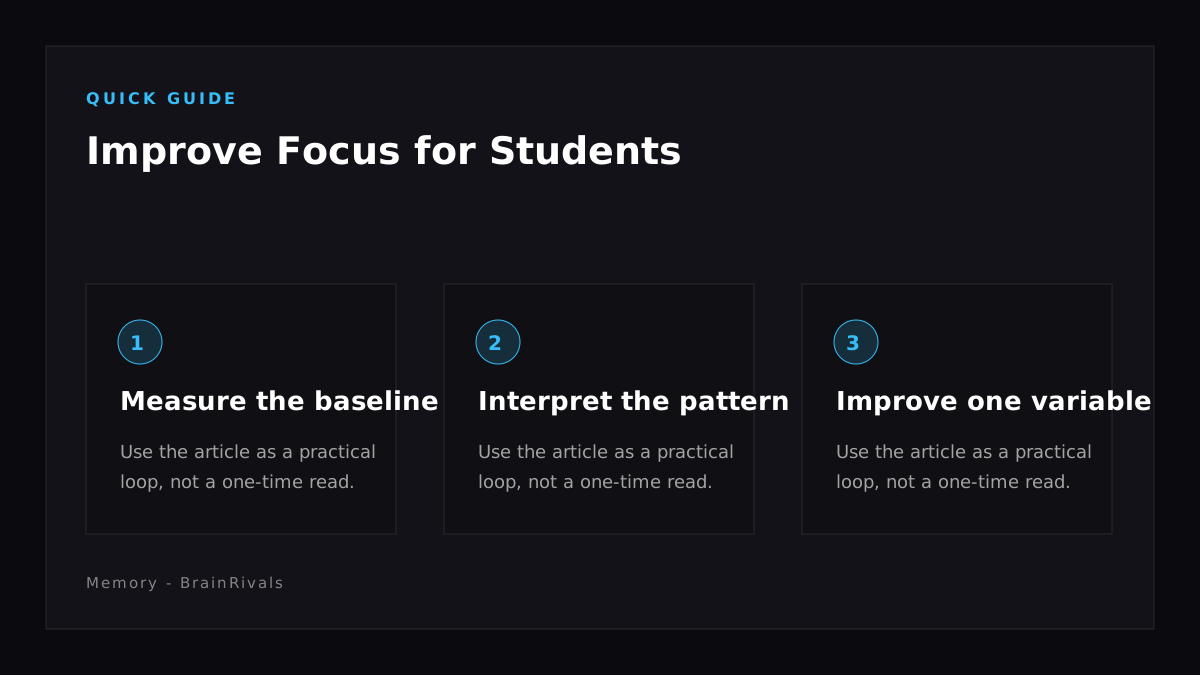
This guide turns an abstract idea about memory into something you can notice, measure, and improve. The fastest way to use it is to read the benchmark first, compare it with your own context, then run a related BrainRivals test under the same conditions for a cleaner before-and-after signal.
Key takeaways
- Start with the practical benchmark, not the trivia.
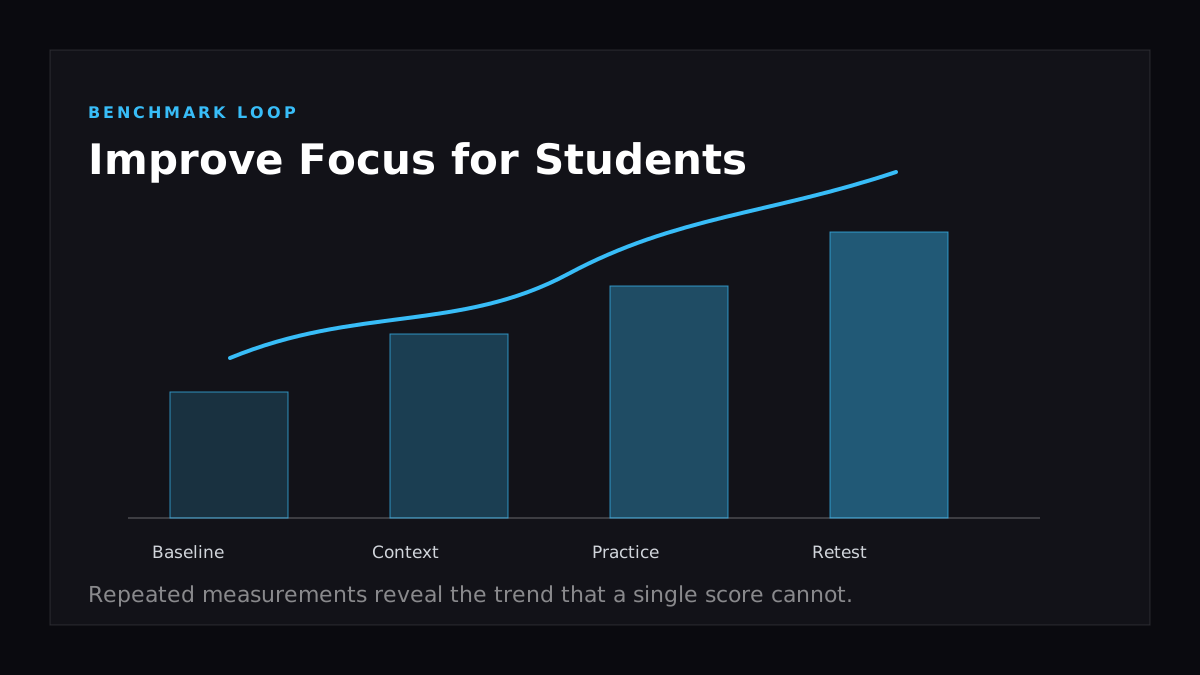
- Treat one score as a snapshot and repeated scores as the real signal.
- Use the Verbal Memory as the next measurable step.
How to Use This Guide
Use the article in three passes: scan the quick answer, check the tables or examples that match your situation, then pick one action to test this week. That keeps the article useful even if you only have a few minutes, while still giving you enough detail to come back for deeper context.
The biggest lie about studying is that time invested equals learning achieved. A student can spend 8 hours in the library and retain almost nothing. Another spends 2 hours with focused techniques and aces the exam. The difference isn't intelligence—it's how they study.
Neuroscience has figured out what actually works. The methods are counterintuitive. Most students do the exact opposite.
Why Focus Matters More Than Raw Time
Your brain has a limited working memory capacity: typically 5-9 items at once. When you try to force more, older items fall out and you have to reload them. This is cognitive load.
High cognitive load = poor learning and retention.
The goal of good study technique is to manage cognitive load so your brain can actually consolidate information into long-term memory.
Spaced Repetition: The Master Technique
Spaced repetition is the single most researched and effective learning method. The principle is simple: review material at increasing intervals before you forget it.
This isn't new. Ebbinghaus documented the "forgetting curve" in 1885: you forget ~50% of new information within 1 day, ~70% within 1 week. But if you review right before the forgetting point, retention jumps to ~90% and the forgetting curve resets at a slower rate.
The schedule:
- Learn material (day 0)
- Review after 1 day
- Review after 3 days
- Review after 1 week
- Review after 2 weeks
- Review before the exam
Why this works neurologically:
- First review strengthens weak connections in your hippocampus
- Subsequent reviews consolidate to long-term memory in cortex
- Each retrieval attempt strengthens retrieval pathways (makes recall easier)
- Spacing prevents habituation – massed practice (cramming) feels productive but creates weak memories
Practical implementation:
- Use flashcard apps (Anki, Quizlet) that automate spacing
- Or manually schedule reviews in your calendar
- Even crude spacing beats massed practice: reviewing Friday, then Tuesday is better than reviewing Friday and Saturday
Active Recall vs. Passive Re-reading
Students default to passive strategies: re-reading notes, highlighting, watching videos. These feel productive but are largely useless for retention.
Passive approach: Open textbook, re-read chapter → feels familiar → feels like learning → retention is ~5%
Active recall: Close the book, write down what you remember → struggle for answers → look up what you missed → try again
The second approach feels harder and slower. It also creates 10x better retention.
Why? Because retrieval difficulty drives memory strength. When you force your brain to retrieve information, you strengthen the neural pathways for that retrieval. Passive exposure doesn't trigger retrieval.
Research consistently shows:
- Re-reading: ~5-10% retention
- Testing yourself: ~50-70% retention
- Spaced retrieval practice: ~80-90% retention
Practical active recall methods:
- Close-book tests (practice problems, flashcards, quizzes)
- Teach-back method (explain to a friend or imaginary audience)
- Mind mapping from memory
- Practice problems with increasing difficulty
The Pomodoro Technique: Focus Blocks
The Pomodoro Technique is a time management method, but it works because it respects your brain's attention span:
- 25 minutes of focused work (no distractions)
- 5 minute break (walk, water, phone)
- Repeat 4 times
- 15-30 minute longer break
Why 25 minutes? Studies on attention span show that focused concentration naturally degrades after 20-30 minutes. Building in breaks prevents cognitive fatigue and actually speeds up learning.
The key is no distractions: phone off, notifications silenced, single task focus.
One pomodoro of active recall beats three hours of passive re-reading.
Working Memory Capacity and Learning
Your working memory is your learning bottleneck. You can't hold more than 5-9 items in mind simultaneously, so if you're trying to learn something complex with many moving parts, you'll hit the ceiling.
This has practical implications:
- Learning complex material? Break it into smaller chunks
- Not remembering what you studied yesterday? Your working memory was overloaded during study
- Trouble multitasking while studying? Your WM is full; eliminate the other task
You can measure your working memory capacity with digit span tests (memorize increasingly long number sequences). Average adult capacity is 7 digits. If you can handle 6, you're below average. If you can handle 9+, you're above average.
Why this matters: if your WM capacity is 6 items and you're trying to learn a concept with 8 elements, you'll need to chunk it into smaller sub-concepts first. Trying to force it doesn't work.
Building a Focus Warm-Up Routine
Here's where BrainRivals fits into your study workflow:
Before your study session, take 5-10 minutes to do a cognitive warm-up:
- Reaction Time test (2 min) – primes your visual and motor systems
- Verbal Memory test (3 min) – activates language centers
- Number Memory test (3 min) – warms up working memory
Why? Your brain's performance isn't static. Cold performance is worse than warm performance. Athletes warm up before competing. Your brain should too.
You'll notice:
- Faster processing speed during study
- Better focus and fewer distractions
- Improved performance on the first test/quiz
This is a real effect. Performance improves ~10-15% after cognitive warm-up.
A Complete Study System
Here's how to combine these methods:
| Phase | Duration | Method |
|---|---|---|
| Warm-up | 5-10 min | BrainRivals tests |
| Study Block 1 | 25 min | Active recall (problems, flashcards) |
| Break | 5 min | Walk, hydrate |
| Study Block 2 | 25 min | Active recall on new material |
| Break | 5 min | Rest |
| Study Block 3 | 25 min | Spaced review of old material |
| Long Break | 15-30 min | Complete mental break |
Daily study: 2-3 cycles = 1.5-2 hours of actual learning
Before exam: Schedule spaced reviews 1 week out, then daily the week before
Common Mistakes to Avoid
- Highlighting as a study method – feels productive, retention ~3%
- Re-reading with no testing – passive, retention ~5%
- Studying the same material repeatedly (cramming) – no spacing, retention drops within days
- Multi-tasking while studying – divides attention, halves effective learning
- Not sleeping before exams – sleep consolidates memories; 4 hours of sleep before an exam is worse than studying those 4 hours
Start tonight: pick one subject, study one topic using Verbal Memory and Number Memory tests as warm-ups, then active recall for 25 minutes. Compare your retention to your last cram session. You'll see the difference immediately.
Try It on BrainRivals
Reading about the concept is useful, but a repeatable score is more actionable. Run the Verbal Memory, Number Memory and Sequence Memory tests, save your result, then repeat under similar conditions later. The trend matters more than a single best attempt.