Dual N-Back Training Explained: The Most Studied Brain Game in Science
Get the short answer first, then use the benchmarks, examples, and BrainRivals practice links to turn the idea into a measurable result.
Quick Answer
This guide turns an abstract idea about memory into something you can notice, measure, and improve. The fastest way to use it is to read the benchmark first, compare it with your own context, then run a related BrainRivals test under the same conditions for a cleaner before-and-after signal.
Key takeaways
- Start with the practical benchmark, not the trivia.
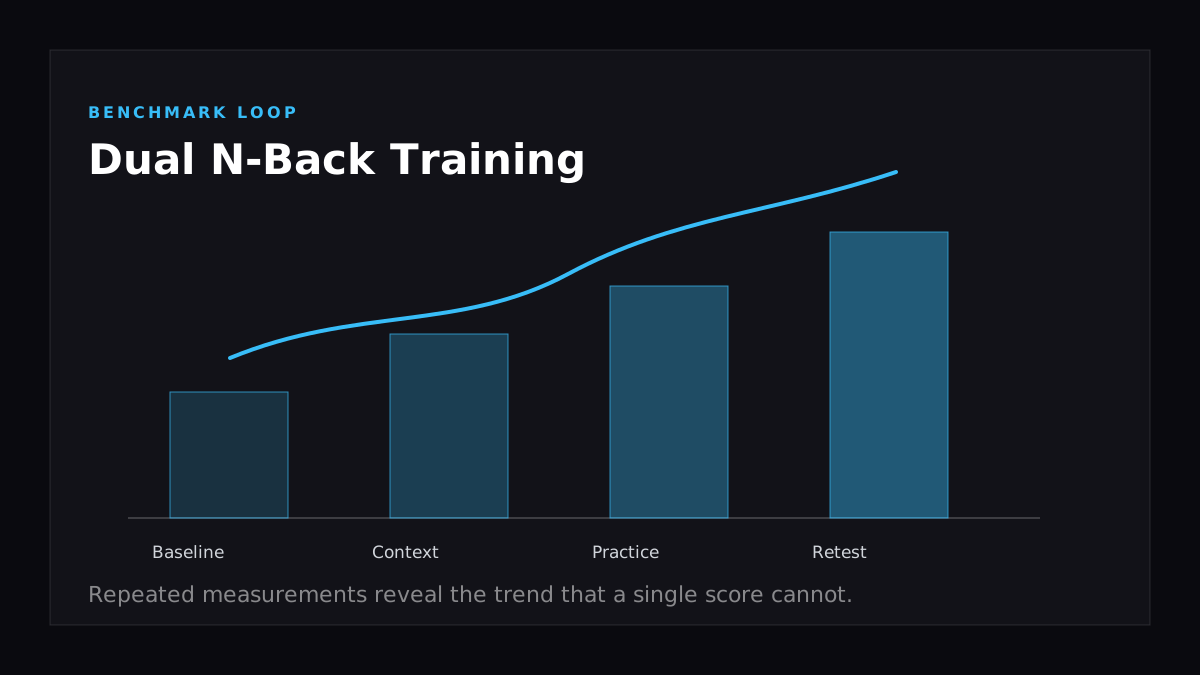
- Treat one score as a snapshot and repeated scores as the real signal.
- Use the Sequence Memory as the next measurable step.
How to Use This Guide
Use the article in three passes: scan the quick answer, check the tables or examples that match your situation, then pick one action to test this week. That keeps the article useful even if you only have a few minutes, while still giving you enough detail to come back for deeper context.
What Is Dual N-Back?
Dual N-Back is a working memory exercise developed for cognitive psychology research and popularized by a 2008 paper that claimed it could raise fluid intelligence — a claim that started one of the largest replication debates in modern cognitive science.
The mechanics are simple. You watch a sequence of two streams simultaneously:
- A square moves around a 3×3 grid, one position at a time
- A letter is spoken aloud (or shown on screen) at each step
Your job, on each new step, is to indicate whether the current position matches the position from N steps ago, AND whether the current letter matches the letter from N steps ago.
At N=2, you're tracking what happened two steps back across two channels at once. At N=4, four steps back. The cognitive load is brutal — and that's the point.
Why It's Different From Other Brain Games
Most brain training games train the specific skill they test. Better at the game, no transfer to anything else.
Dual N-Back is unusual because it stresses the central executive of working memory — the system that manages multiple streams of information simultaneously. The hypothesis: train the executive directly, and benefits should generalize across cognitive tasks that depend on it.
Whether this hypothesis is correct is the entire debate.
What the Research Actually Says
The 2008 Jaeggi paper
Jaeggi et al. (2008, PNAS) reported that 19 days of Dual N-Back training raised participants' performance on Raven's Progressive Matrices — the gold-standard fluid intelligence test. This was a big deal because fluid intelligence had been considered largely fixed in adults.
The replication problem
Subsequent attempts at replication produced mixed results:
- Some studies (Au et al. 2015 meta-analysis) found small but consistent transfer effects
- Others (Redick et al. 2013, Melby-Lervåg & Hulme 2016) found no meaningful transfer to untrained tasks
- The clearest finding: training improves performance on Dual N-Back itself substantially, and on closely-related working memory tasks moderately, but transfer to fluid intelligence is small to negligible in most studies
What we can confidently say
After two decades of research:
- Dual N-Back reliably improves working memory capacity for similar tasks
- Transfer to untrained working memory tasks is small but present
- Transfer to fluid intelligence is unreliable across studies
- Training effects decay rapidly without continued practice
So is it worth doing? It depends on what you want.
Who Should Train Dual N-Back
It's a reasonable use of training time if:
- You want stronger working memory specifically (useful for studying, complex problem-solving, programming)
- You enjoy a challenging game and don't mind frustration
- You're looking for a focused 20-minute daily mental workout
It's probably not the best choice if:
- You're hoping for a general IQ boost — the evidence is weak
- You want immediate quality-of-life improvements (sleep and exercise produce more)
- You don't enjoy the task — adherence beats theoretical optimality every time
How to Train Dual N-Back Effectively
Sessions
The classic Jaeggi protocol is 20 minutes per day, 5 days per week, for 4–8 weeks. Each session contains 20 blocks of 20+N trials.
Progression rule
Standard progression:
- Above 80% accuracy on a level → next session at N+1
- 60–80% accuracy → repeat current N
- Below 60% → drop back to N–1
Most beginners start at N=2 and reach N=4–6 within 4–6 weeks. Top performers reach N=8–10. Beyond that is rare and possibly meaningless — at high N levels, success often comes from chunking strategies rather than raw working memory.
Avoid pseudo-strategies
The real working memory benefit comes from genuinely holding all positions and letters in active memory. Common shortcuts that look like progress but aren't:
- Verbalizing the position grid in patterns ("middle, top-right, bottom...")
- Treating the audio stream as a chant rhythm
- Making rough guesses based on familiarity
If you find yourself doing these, drop a level and rebuild.
Free training tools
Brain Workshop is the original open-source implementation and remains the standard. Several mobile apps replicate it with varying fidelity.
How Dual N-Back Relates to Other Memory Skills
Working memory has multiple components, and different tests target different aspects:
| Test | Working memory subsystem |
|---|---|
| Dual N-Back | Central executive + dual-channel maintenance |
| Number Memory | Verbal working memory (digit span) |
| Sequence Memory | Visuospatial working memory |
| Visual Memory | Visuospatial pattern memory |
Dual N-Back is the most demanding of these because it forces simultaneous tracking of two streams. The others isolate single subsystems and can be tracked over time on BrainRivals to monitor improvement.
Realistic Timeline and Expectations
| Week | Typical N-level | What to expect |
|---|---|---|
| 1 | N=2 | Dial in the rhythm, frequent missed trials |
| 2 | N=2–3 | First "I can do this" moments |
| 4 | N=3–4 | Steady plateau-and-break pattern |
| 6 | N=4–5 | Genuine working memory feels stretched |
| 8 | N=5–6 | Diminishing returns begin for most people |
Past 8 weeks, gains slow significantly and the cost-benefit ratio drops. Many practitioners taper to 2–3 sessions per week as maintenance, or rotate to other tasks.
What Gains You Can Reasonably Expect
Based on the more rigorous studies:
- Strong: Improvements on Dual N-Back itself (often 2–3 N levels)
- Moderate: Better performance on similar working memory tasks
- Weak: Better performance on tasks that depend on working memory but aren't directly related (mental arithmetic, reading comprehension)
- Inconsistent: Improvements in fluid intelligence, IQ tests, or general cognitive function
Don't expect dramatic real-world changes. Do expect meaningful gains within working-memory-dependent tasks.
Try It on BrainRivals
Reading about the concept is useful, but a repeatable score is more actionable. Run the Sequence Memory, Number Memory and Visual Memory tests, save your result, then repeat under similar conditions later. The trend matters more than a single best attempt.
Frequently Asked Questions
Does Dual N-Back actually raise IQ?
The evidence is mixed and the effect, if real, is small. Some meta-analyses suggest a modest improvement on fluid intelligence measures (4–5 IQ points), but several rigorous replications found no transfer at all. The honest answer: probably a small effect for some people, not a guaranteed effect for anyone.
How long until I see results?
Improvements on the task itself appear within the first 1–2 weeks. Transfer to other tasks (if it happens for you) typically takes 4–6 weeks of consistent training. The effects fade within weeks of stopping.
Is Dual N-Back better than other brain training games?
For working memory specifically, yes — it's one of the most demanding working-memory training tasks ever designed. For general cognitive improvement, it's not clearly better than other interventions, and dramatically less effective than sleep, exercise, and reducing chronic stress.
What N-level is good?
Average untrained adults max out around N=2–3. Regular trainees reach N=4–6 within 6–8 weeks. N=7+ is exceptional. The number itself matters less than consistent improvement.
Can children do Dual N-Back?
Yes, with simplified versions. The full dual-channel task is generally too demanding before age 9–10. Single N-Back (one channel only) is more appropriate for children and shows similar working memory benefits.
Should I do Dual N-Back if I already train other memory tasks?
Yes, if you have time. The other BrainRivals memory tests train different subsystems. Dual N-Back specifically stresses the central executive, which most other tasks don't isolate. They complement rather than overlap.