Screen Time and Attention Span: What the Research Actually Shows
Get the short answer first, then use the benchmarks, examples, and BrainRivals practice links to turn the idea into a measurable result.
Quick Answer
This guide turns an abstract idea about focus into something you can notice, measure, and improve. The fastest way to use it is to read the benchmark first, compare it with your own context, then run a related BrainRivals test under the same conditions for a cleaner before-and-after signal.
Key takeaways
- Start with the practical benchmark, not the trivia.
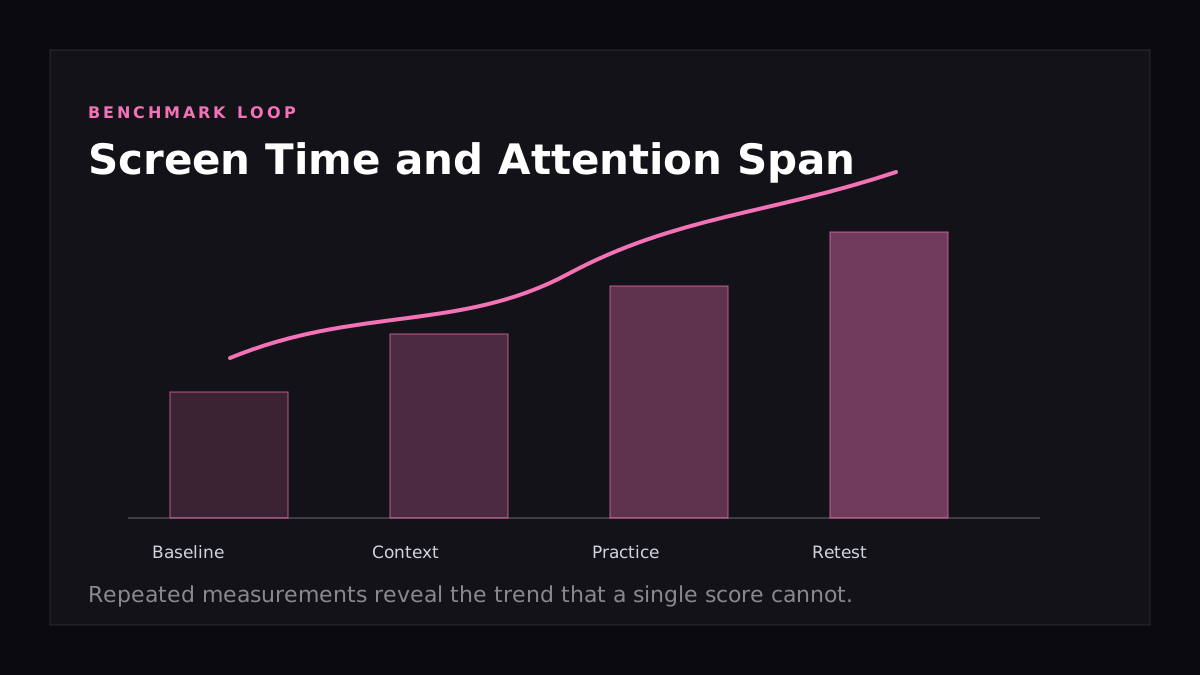
- Treat one score as a snapshot and repeated scores as the real signal.
- Use the Reaction Time as the next measurable step.
How to Use This Guide
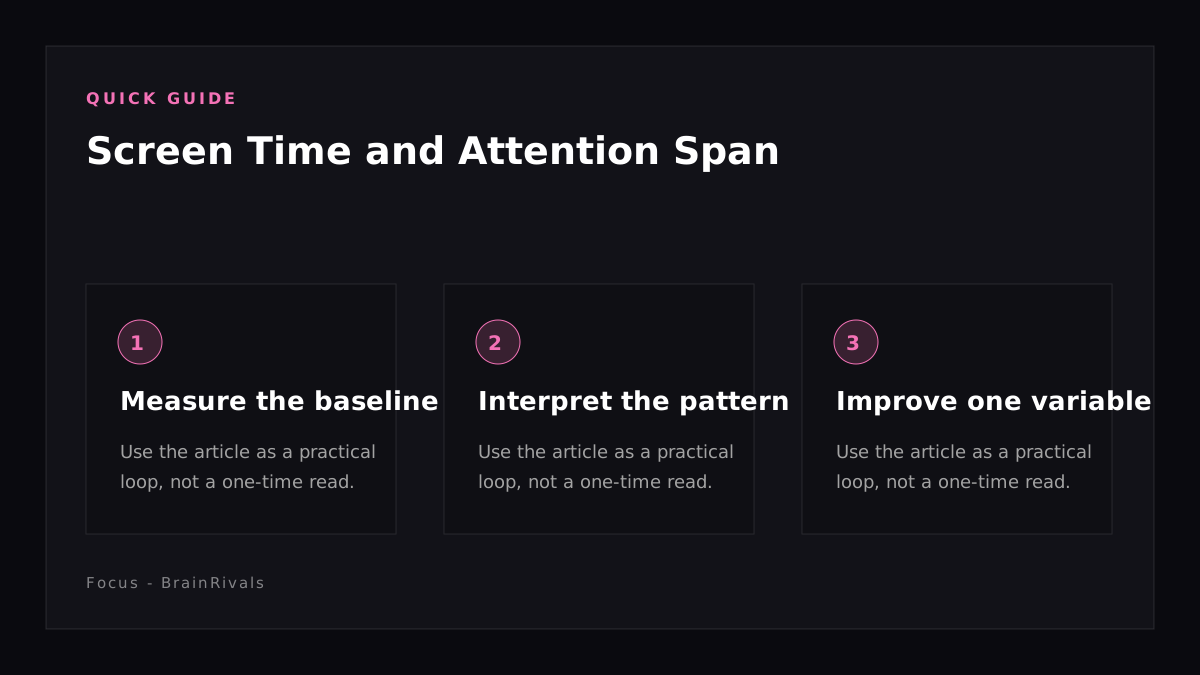
Use the article in three passes: scan the quick answer, check the tables or examples that match your situation, then pick one action to test this week. That keeps the article useful even if you only have a few minutes, while still giving you enough detail to come back for deeper context.
The Myth You've Probably Heard
You've seen the claim: "The average human attention span has dropped to 8 seconds — shorter than a goldfish."
It's fake. The statistic was attributed to a Microsoft study that didn't actually conclude that, and the goldfish comparison was never substantiated by any research. Cognitive scientists have repeatedly debunked it.
What is real is that how we deploy attention has changed — and screens are part of that story. The honest research picture is more useful than the viral statistic.
What "Attention Span" Even Means
There's no such thing as a single "attention span." The term lumps together at least four distinct cognitive abilities:
- Sustained attention — keeping focus on one task over time
- Selective attention — filtering relevant information from noise
- Divided attention — managing multiple inputs at once
- Executive attention — top-down control of where focus goes
Different screen activities affect these differently. Saying "screens shorten attention" is like saying "food makes you sick" — depends entirely on which food.
You can measure your sustained attention indirectly through tasks like the BrainRivals Reaction Time Test repeated 20+ times — performance variance over the session reflects sustained attention quality.
What the Research Actually Shows
Heavy media multitasking correlates with worse selective attention
Stanford researchers (Ophir, Nass, Wagner 2009) found that heavy media multitaskers performed worse on selective attention tasks than light multitaskers. They were more distracted by irrelevant information and switched between tasks less efficiently — the opposite of what they thought.
This has been replicated multiple times. It's one of the more robust findings in the field.
Short-form video content correlates with reduced sustained attention
A 2024 study tracked university students' attention patterns alongside short-form video consumption (TikTok, Reels, Shorts). Heavy users showed measurably reduced sustained attention on standardized tasks — a roughly 5–10% drop versus light users.
The mechanism appears to be conditioning: the brain adapts to expecting novelty every 15–60 seconds, and long-form attention requires actively suppressing that expectation.
Action video games can improve certain attentional skills
Counterintuitively, action video gamers consistently outperform non-gamers on selective attention, visual search, and tracking multiple objects simultaneously (Green & Bavelier, Nature, 2003 and many follow-ups).
Different screen activities pull in different directions. The medium isn't the message — the activity is.
Background screens fragment attention even when not used
Even unused screens (TV on in the background, phone visible on desk) measurably reduce performance on focus-demanding tasks. The mere presence of a smartphone in the room reduces working memory and selective attention by a small but consistent amount (Ward et al. 2017).
The Attentional Cost of Modern Phone Use
Three specific patterns produce the most damage:
1. Constant context switching
The average knowledge worker switches tasks every 3 minutes during a typical workday. Each switch incurs a "switch cost" — roughly 15–30 seconds of reduced performance as the brain reloads context.
If you switch every 3 minutes for 8 hours, you spend somewhere between 40 minutes and 2 hours of your workday in switch cost. The constant loading prevents deep cognitive states from forming.
2. Notification-driven attention
Every notification trains the brain to expect the next one. The dopamine-anticipation loop is identical to slot-machine reinforcement — variable reward schedules are the most addictive pattern in behavioral psychology.
After enough conditioning, attention becomes notification-shaped: it can hold for short bursts but cannot sustain.
3. Infinite-scroll consumption
Endless feeds (TikTok, Twitter, Instagram, Reddit) train short attention windows because they reward swiping for novelty. Half an hour of infinite-scrolling is half an hour of practicing 30-second attention spans.
What Actually Restores Attention
Attention is trainable in both directions. The same brain that can shorten attention can rebuild it. The interventions with the strongest evidence:
Sustained reading
Reading a book for 30+ minutes is one of the most direct attention-rebuilding exercises. It demands the kind of sustained, top-down focus that short-form content erodes. Regular long-form reading consistently correlates with better sustained attention scores.
Mindfulness meditation
Decades of research support meditation as an attention training tool. Even 8 weeks of 15-minute daily practice produces measurable improvements in sustained and selective attention.
Deliberate practice on focus-demanding tasks
Cognitive tasks that require uninterrupted attention rebuild the underlying capacity. Sessions on the BrainRivals Aim Trainer or Verbal Memory Test work for this — the demand is high and the feedback is immediate.
Single-tasking by design
Build environments that make multitasking hard:
- Phone in another room (not just out of sight)
- Single-tab browsers, full-screen apps
- Notifications off by default, not "do not disturb mode"
- Specific time blocks for email and messaging
Aerobic exercise
Regular cardio improves sustained attention through several pathways: increased prefrontal blood flow, BDNF (brain-derived neurotrophic factor) release, and better sleep quality. The effect is consistent across age groups.
Sleep
Attention is among the first cognitive systems to degrade under sleep debt. A single night of 6 hours instead of 8 reduces sustained attention measurably. Two consecutive nights compound the effect.
What About Children?
The picture for children is more concerning, because their attention systems are still developing:
- Heavy short-form video use in children under 12 correlates with attention difficulties at school
- Co-viewing and parent-mediated screen use produce much smaller effects than solo consumption
- Educational, slower-paced content produces no measurable harm in moderate amounts
- Pre-bedtime screen use disrupts sleep, which secondarily disrupts daytime attention
The American Academy of Pediatrics' guidelines (no screens under 18 months, limited and co-viewed for ages 2–5, consistent limits with content quality emphasis for older children) reflect the consensus reasonably well.
How to Audit Your Own Attention
A simple weeklong test:
- On day 1, attempt 30 minutes of uninterrupted reading. Note how long until the urge to check your phone appears.
- On day 2, take a baseline on the BrainRivals Reaction Time Test — 20 attempts. Variance over the session reflects sustained attention.
- For the next 5 days, reduce short-form video and notifications, and add 30 minutes of book reading daily.
- Repeat both tests on day 7. Most people see meaningful improvement.
The Honest Verdict
The evidence supports a simple, non-alarmist conclusion: screens are not destroying human attention, but specific patterns of screen use are conditioning shorter attention windows for the people who heavily engage with them. The damage is reversible. The main lever is what you do on screens, not just how long.
Heavy short-form video and constant context switching weaken sustained attention. Long-form reading, demanding cognitive tasks, and focused single-tasking strengthen it. The brain calibrates to demand in either direction.
Try It on BrainRivals
Reading about the concept is useful, but a repeatable score is more actionable. Run the Reaction Time, Verbal Memory and Aim Trainer tests, save your result, then repeat under similar conditions later. The trend matters more than a single best attempt.
Frequently Asked Questions
Are humans' attention spans really getting shorter?
Population-level cognitive testing doesn't support a dramatic decline. What's measurably changed: more people use attention in fragmented, multitasking patterns, and that pattern weakens sustained attention over time. The capacity isn't shrinking — its expression is shifting.
How long should I limit my screen time?
Total hours matters less than what you're doing in those hours. Two hours of focused work is fine; two hours of infinite scrolling will degrade attention measurably over weeks. Audit by activity, not just total time.
Do blue light glasses help attention?
No, despite the marketing. Blue light glasses primarily address sleep timing (some evidence for evening use), not attention. The attention problems associated with screens come from content patterns, not the light wavelength itself.
Is multitasking ever okay?
Brief multitasking on automatic tasks (folding laundry while on a call) is harmless. Sustained multitasking on cognitively demanding tasks consistently underperforms single-tasking — the human brain isn't actually capable of parallel processing of complex tasks. It's just rapid switching with switch costs.
Can video games improve attention?
Action games (FPS, real-time strategy) consistently improve selective and divided attention in research. Casual mobile games and short-form gaming have less evidence. Hours-per-day matters: moderate gaming (1–2 hours) shows benefits; very heavy gaming (5+ hours) tilts negative because of opportunity cost on other attention-building activities.
How fast can attention recover after heavy short-form use?
Reasonably fast. Two to four weeks of reduced short-form consumption combined with active attention training (long-form reading, meditation, focus-demanding tasks) produces measurable improvement in most adults. Full recovery from years of heavy use takes longer but follows the same trajectory.