Mental Math Shortcuts: Speed Up Your Quantitative Reasoning
Get the short answer first, then use the benchmarks, examples, and BrainRivals practice links to turn the idea into a measurable result.
Quick Answer
This guide turns an abstract idea about brain training into something you can notice, measure, and improve. The fastest way to use it is to read the benchmark first, compare it with your own context, then run a related BrainRivals test under the same conditions for a cleaner before-and-after signal.
Key takeaways
- Start with the practical benchmark, not the trivia.
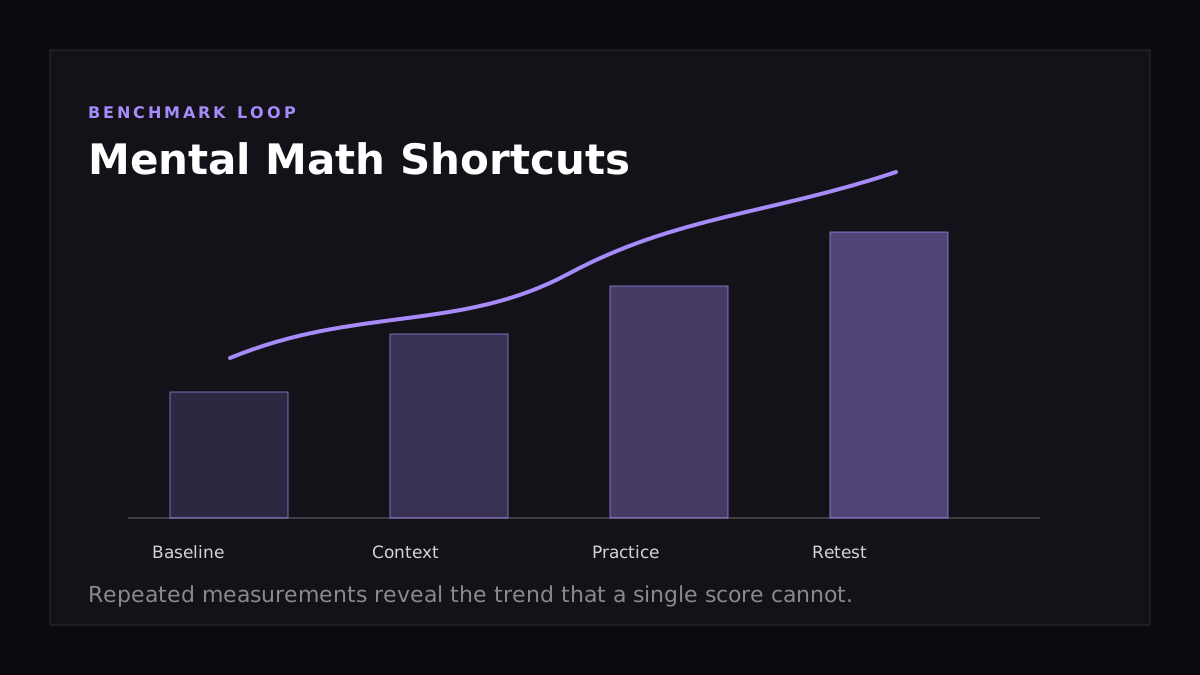
- Treat one score as a snapshot and repeated scores as the real signal.
- Use the Number Memory as the next measurable step.
How to Use This Guide
Use the article in three passes: scan the quick answer, check the tables or examples that match your situation, then pick one action to test this week. That keeps the article useful even if you only have a few minutes, while still giving you enough detail to come back for deeper context.
Most people assume mental math requires a special gift. You're either a "math person" or you're not. Wrong. Fast mental arithmetic is learnable. It's a skill, not a talent. And mastering a few key techniques will transform your quantitative reasoning speed.
The correlation between mental math speed and working memory capacity is strong. But here's the catch: the right algorithms reduce working memory demand. Fast mental math isn't about having more memory—it's about using smarter algorithms that require less memory.
Why Speed Matters in Cognitive Performance
Before diving into techniques, understand why this matters:
Working Memory Efficiency: Fast mental math reduces cognitive load. When you calculate 23 × 17 using the standard right-to-left method, you hold multiple partial products in working memory simultaneously. Using shortcuts, you calculate left-to-right, holding fewer items.
Real-Time Problem Solving: In tests and real life, faster calculation frees up working memory for higher-level reasoning. You're not bogged down in arithmetic; you can focus on strategy.
Confidence and Flow: Speed creates momentum. Quick calculations feel satisfying and build confidence, which improves performance on subsequent problems.
The people who ace quantitative reasoning tests often aren't smarter—they're faster at the mechanical parts, freeing their working memory for actual reasoning.
Vedic Math: Left-to-Right Calculation
Vedic mathematics, an ancient Indian system, emphasizes left-to-right calculation. This is counterintuitive if you learned right-to-left in school, but it's more natural for working memory.
Example: 23 × 17
Standard Method (Right-to-Left):
    23
  × 17
  ----
   161  (23 × 7)
+  230  (23 × 10)
  ----
   391
You calculate the ones column, then the tens, holding partial products in working memory.
Vedic Method (Left-to-Right):
23 × 17:
- 20 × 17 = 340
- 3 × 17 = 51
- 340 + 51 = 391
Or:
23 × 17:
- 23 × 10 = 230
- 23 × 7 = 161
- 230 + 161 = 391
The Vedic approach breaks multiplication into smaller chunks, each calculated in sequence. Your working memory holds only one partial product at a time, not multiple.
Why This Works Better
Left-to-right calculation reduces working memory demand because:
- Sequential processing: One step at a time, one result at a time
- Commutative advantage: You choose the order that's easiest for you
- Error detection: If you make a mistake, you catch it early
- Approximation: Early partial results give you a running estimate
Practice Left-to-Right Multiplication
Start with two-digit numbers:
- 12 × 14
- 25 × 13
- 31 × 22
Then three-digit numbers:
- 123 × 14
- 256 × 12
Work through 10–15 problems daily for a week. You'll develop automaticity. Within weeks, two-digit multiplication becomes nearly as fast as calculator input, without requiring a device.
Chunking Numbers
Chunking is grouping digits into meaningful units to reduce cognitive load.
Example: Remember 3.14159265 by chunking into dates and recognizable numbers: "3-14-15-92-65" or "March 14, 1592, 65 [something]."
Or more usefully for calculations, chunk numbers to exploit mathematical structure.
Example: 47 × 13
Don't see "47 × 13." See "47 × (10 + 3)" or "(50 - 3) × 13."
Using (50 - 3) × 13:
50 × 13 = 650
3 × 13 = 39
650 - 39 = 611
You've converted a two-digit multiplication into easier operations using decomposition.
Strategic Chunking Rules
For multiplication near round numbers:
- 47 × 13 → (50 - 3) × 13 = 650 - 39
- 89 × 11 → (90 - 1) × 11 = 990 - 11
- 52 × 48 → (50 + 2) × (50 - 2) = 2500 - 4 (difference of squares)
For numbers ending in 5:
- 25 × 24 = 25 × (25 - 1) = 625 - 25
- 35 × 35 = (35)² = (30 + 5)² = 900 + 300 + 25
For numbers with repeating digits:
- 99 × 12 = (100 - 1) × 12 = 1200 - 12
- 11 × 23 = 10 × 23 + 23 = 230 + 23
The principle: Chunk numbers into components that are easier to multiply, then combine the results.
Estimation: The Underrated Skill
Estimation is faster and often more useful than exact calculation.
Example: "What's 47 × 13 approximately?"
- 47 ≈ 50, 13 ≈ 10
- 50 × 10 = 500
- Actual: 611
- Error: ~8%
For many real-world applications, knowing an answer is "around 600" is sufficient. And estimation is much faster—one or two mental operations versus multiple.
When to Estimate
Strategic estimation (quick approximation for feasibility): "Will this fit? Will this cost more than my budget? Is this answer reasonable?" → Estimate
Exact calculation (when precision is required): "What's the exact change? What's the precise measurement?" → Calculate
Most people spend too much time on exact calculation when estimation would suffice.
Estimation Techniques
Rounding to convenient numbers: 47 → 50, 13 → 10
Recognizing magnitudes: 47 × 13 is "something around 500–600" because it's "about 50 × 10 to 50 × 20"
Proportional reasoning: If 10 × 10 = 100, then 50 × 10 = 500, and 50 × 20 = 1000, so 50 × 13 is in between
Significant figures: Report only as much precision as your input warrants. If inputs are approximate, output should be too.
Working Memory and Mental Math Speed
Here's the neuroscience piece: faster mental math directly correlates with working memory capacity.
But it's bidirectional:
Fast arithmetic → Lower memory demand → More capacity for complex problems
Working memory training → Faster information retrieval → Faster arithmetic
This is why Number Memory training at BrainRivals helps mental math. You're training the speed at which your brain retrieves and manipulates numeric information.
Training approaches:
Digit span drills: Rehearse number sequences of increasing length, building phonological loop capacity.
Arithmetic fluency: Practice single-digit arithmetic (5 + 7, 12 - 8, 3 × 6) until responses are automatic. This reduces working memory demand for larger calculations.
Multi-step problems: Hold intermediate results while calculating the next step. This trains central executive function.
Example: Calculate 23 + 47 - 18 without writing it down.
- 23 + 47 = 70 (hold this)
- 70 - 18 = 52
- Answer: 52
You're maintaining an intermediate result while performing the next operation. Doing this repeatedly, accurately, and quickly trains working memory.
Practical Training Progression
Week 1: Master left-to-right two-digit multiplication
- Daily: 10 problems, 23 × 17 level
- Target: Complete in <10 seconds each
Week 2: Add chunking strategies
- Daily: 5 two-digit problems using decomposition (e.g., 47 × 13 as (50 - 3) × 13)
- Plus 5 problems without tricks, for comparison
Week 3: Add estimation
- Daily: Estimate 10 two-digit multiplications
- Then calculate exactly; compare error
Week 4: Three-digit numbers
- Daily: 5 three-digit × two-digit problems using left-to-right method
- Target: Complete in 15–20 seconds
Week 5+: Maintenance and complexity
- Daily: 5 problems of increasing difficulty
- Vary the techniques to maintain flexibility
The Connection to Intelligence Tests
Mental math speed predicts performance on intelligence tests, particularly timed quantitative reasoning sections.
Why? Because:
- Working memory: Quantitative tests demand holding multiple constraints and intermediate results
- Processing speed: Faster calculation means more time for reasoning
- Confidence: Fast mental math reduces test anxiety
- Transfer: Efficiency in basic operations transfers to complex problem-solving
People who train mental math shortcuts often see 10–15% improvement in quantitative reasoning test scores, even without improving underlying mathematical knowledge.
The Neuroscience Bonus
Mental math training builds neural efficiency in:
- Dorsolateral prefrontal cortex: Working memory and executive function
- Parietal cortex: Numeric processing and quantity representation
- Temporal lobe: Retrieval of arithmetic facts from long-term memory
Regular practice increases gray matter volume in these regions and strengthens white matter connectivity. This suggests that mental math training is building fundamental cognitive structures, not just learning tricks.
Realistic Expectations
You won't become a human calculator in two weeks. But with consistent practice:
- Month 1: 20–30% speed improvement in two-digit mental multiplication
- Month 2–3: Three-digit calculations become fluent
- Month 3+: Gains plateau as you reach the limits of working memory-based calculation
- Transfer: 5–10% improvement in overall quantitative reasoning performance
The gains are real and useful, but they're not miraculous. You're optimizing a system, not transcending its limits.
The Takeaway
Mental math speed is a trainable skill that directly improves cognitive performance in working memory, quantitative reasoning, and processing speed. It's not about innate talent; it's about learning efficient algorithms (Vedic math, chunking, estimation) and practicing them consistently.
Start with left-to-right multiplication. Add chunking strategies. Practice estimation. Within weeks, you'll calculate faster, with less effort and fewer errors. And that efficiency will free up working memory for higher-level reasoning.
Test your current quantitative speed and working memory with the Number Memory test. Track your baseline, train for a month using these techniques, then retest. The improvement will surprise you.
Try It on BrainRivals
Reading about the concept is useful, but a repeatable score is more actionable. Run the Number Memory and Sequence Memory tests, save your result, then repeat under similar conditions later. The trend matters more than a single best attempt.