Cognitive Exercises for Seniors: Preventing Memory Decline Through Brain Games
Get the short answer first, then use the benchmarks, examples, and BrainRivals practice links to turn the idea into a measurable result.
Quick Answer
This guide turns an abstract idea about brain training into something you can notice, measure, and improve. The fastest way to use it is to read the benchmark first, compare it with your own context, then run a related BrainRivals test under the same conditions for a cleaner before-and-after signal.
Key takeaways
- Start with the practical benchmark, not the trivia.
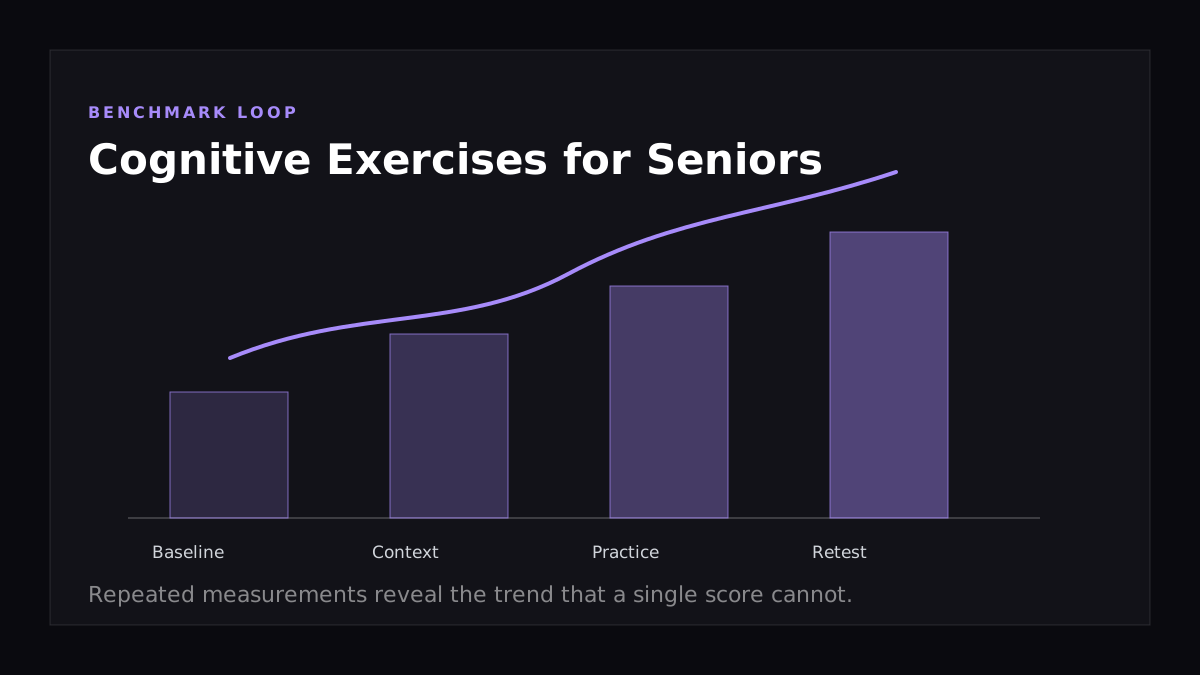
- Treat one score as a snapshot and repeated scores as the real signal.
- Use the Number Memory as the next measurable step.
How to Use This Guide
Use the article in three passes: scan the quick answer, check the tables or examples that match your situation, then pick one action to test this week. That keeps the article useful even if you only have a few minutes, while still giving you enough detail to come back for deeper context.
Cognitive decline in older adults isn't inevitable. Yes, processing speed slows and working memory capacity typically decreases after 60—that's normal aging. But the difference between normal decline and pathological decline (the kind that leads to dementia) is massive. The good news: targeted cognitive exercises can meaningfully slow normal decline and build cognitive reserve that protects against disease.
Normal vs. Pathological Cognitive Decline
Not all memory loss is created equal. Normal aging brings:
- Processing speed decline (~0.5-1% per year after age 60)
- Working memory reduction (holding 5-7 items instead of 7-9)
- Slower recall (accessing information takes longer, but accuracy stays similar)
- Difficulty with divided attention (multitasking gets harder)
Pathological decline (early dementia) looks different:
- Rapid memory loss affecting daily function
- Difficulty with familiar tasks
- Word-finding problems that escalate
- Getting lost in familiar places
- Personality/mood changes
The key distinction: Normal aging affects speed, not accuracy. You forget someone's name temporarily, but remember it later. Pathological decline means you forget you met them at all.
Which Domains Decline First?
Age affects cognitive abilities unevenly:
- Processing speed – declines earliest (40s-50s)
- Fluid intelligence – follows closely (abstract reasoning, pattern recognition)
- Working memory – measurable decline by 60s
- Attention/executive function – moderate decline in advanced age
- Verbal abilities – relatively preserved until very advanced age
- Knowledge/accumulated facts – often improves with age (crystallized intelligence)
This matters because it tells us where to focus training efforts.
The ACTIVE Study: What Actually Works
The most rigorous evidence comes from the Advanced Cognitive Training for Independent and Vital Elderly (ACTIVE) study, a 10-year randomized controlled trial of 2,832 adults aged 65+. Researchers tested three interventions:
- Memory training – mnemonic strategies, chunking, visualization
- Reasoning training – problem-solving patterns and logic
- Processing speed training – rapid visual scanning and decision-making
Results were clear:
- Training improved performance in trained cognitive domains immediately and substantially
- Effects lasted 5+ years (unlike many "brain game" studies that show no durability)
- Booster sessions mattered – decline resumed without them
- Transfer was limited – memory training improved memory but not reasoning
The nuance: cognitive training works, but it's specific. You get better at what you practice.
The Best Cognitive Exercises for Seniors
Based on ACTIVE and follow-up research, these are the highest-yield exercises:
Memory Training
- Number sequences – recall increasingly long digit strings (builds working memory)
- Verbal memory – remembering word lists and stories
- Spatial memory – recalling object locations and paths
Why: Memory decline is most noticeable and frustrating for seniors. These exercises directly combat it.
Processing Speed Training
- Reaction time tasks – simple and choice reaction time
- Rapid scanning – finding targets in visual noise
- Timed decision-making – quick categorization under pressure
Why: Speed is the first casualty of aging. Maintaining processing speed preserves independence and safety (driving, balance, fall prevention).
Reasoning/Logic
- Pattern recognition – identifying sequences and rules
- Problem-solving – working through multi-step challenges
Why: Protects executive function and decision-making ability.
How BrainRivals Tests Map to These Exercises
The platform provides three core cognitive domains:
| Exercise Type | BrainRivals Test | Research Link | Difficulty |
|---|---|---|---|
| Memory (numbers) | Number Memory | ACTIVE | Beginner→Advanced |
| Memory (sequences) | Sequence Memory | Pattern recognition | Beginner→Advanced |
| Speed | Reaction Time | Processing speed training | Beginner→Intermediate |
For seniors specifically, we recommend:
- Start with Reaction Time – 2-3 minutes daily, establishes baseline
- Progress to Number Memory – builds working memory without frustration
- Add Sequence Memory – combines pattern recognition with recall
- Consistency beats intensity – 10 minutes/day, 5 days/week > 1 hour once per month
The Neuroscience Behind Why This Works
When you practice a cognitive task:
- Neural connections strengthen in relevant circuits (dorsolateral prefrontal cortex for working memory, posterior parietal cortex for processing speed)
- Myelination improves – the insulation around neurons, increasing signal speed
- Cognitive reserve builds – redundant neural pathways that compensate when some neurons decline
This is why the ACTIVE study found durability: the brain changes were real and lasting.
Realistic Expectations
Cognitive training won't make you smarter than you were at 30. But it can:
- Slow decline significantly (by 5-10+ years)
- Maintain independence longer
- Improve confidence in daily tasks
- Reduce fall risk through faster reactions
- Protect against cognitive diseases
The catch: benefits require consistency. One week of training followed by months off provides minimal benefit.
Ready to start? Begin with our Reaction Time test to establish your baseline, then move to Number Memory and Sequence Memory for a comprehensive cognitive workout. Consistency beats perfection—10 minutes a day, five days a week is the sweet spot for sustained improvement.
Try It on BrainRivals
Reading about the concept is useful, but a repeatable score is more actionable. Run the Number Memory, Sequence Memory and Reaction Time tests, save your result, then repeat under similar conditions later. The trend matters more than a single best attempt.