Mental Fatigue and Decision-Making: The Hidden Cost of a Long Day
Get the short answer first, then use the benchmarks, examples, and BrainRivals practice links to turn the idea into a measurable result.
Quick Answer
This guide turns an abstract idea about mental performance into something you can notice, measure, and improve. The fastest way to use it is to read the benchmark first, compare it with your own context, then run a related BrainRivals test under the same conditions for a cleaner before-and-after signal.
Key takeaways
- Start with the practical benchmark, not the trivia.
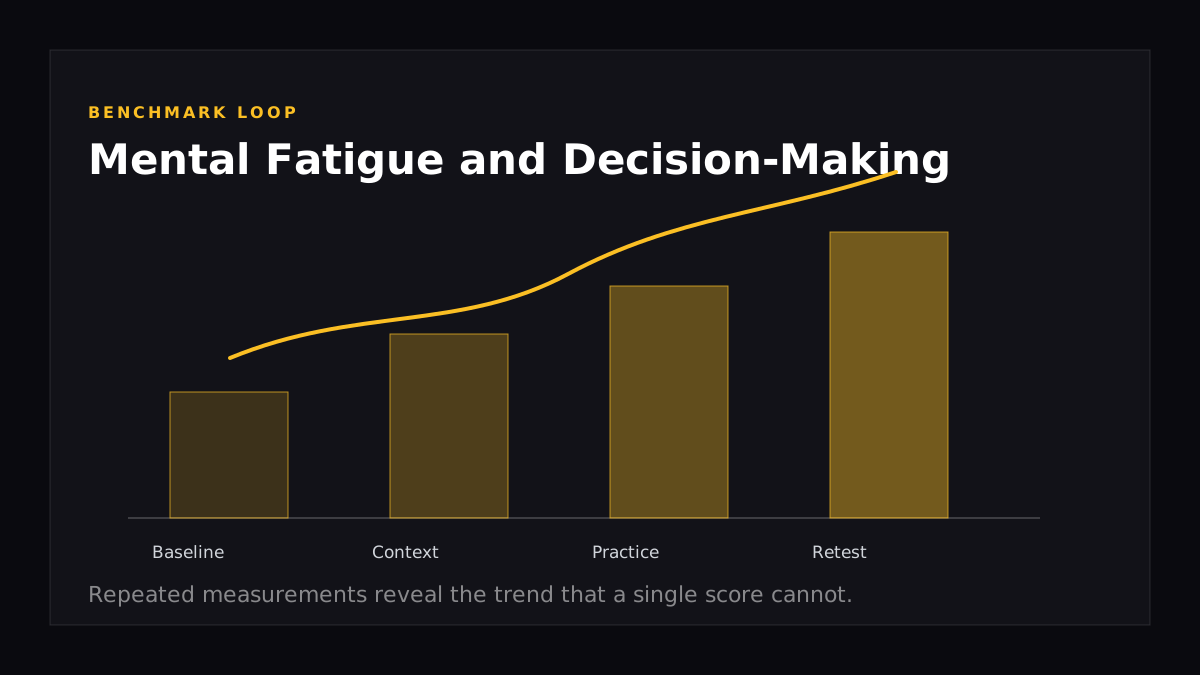
- Treat one score as a snapshot and repeated scores as the real signal.
- Use the Reaction Time as the next measurable step.
How to Use This Guide
Use the article in three passes: scan the quick answer, check the tables or examples that match your situation, then pick one action to test this week. That keeps the article useful even if you only have a few minutes, while still giving you enough detail to come back for deeper context.
What Mental Fatigue Actually Is
Mental fatigue is the measurable decline in cognitive performance that follows sustained mental effort. It's not just "feeling tired" — it produces specific, reproducible deficits:
- Slower reaction times (15–40ms increase by end of day)
- Reduced working memory capacity
- Impaired risk assessment and decision quality
- Lower error detection and self-correction
- Reduced impulse control
The unsettling part: people experiencing mental fatigue typically don't notice their performance has dropped. Subjective feeling lags objective performance by a wide margin.
You can demonstrate this for yourself by taking the BrainRivals Reaction Time Test at 9 AM and again at 5 PM after a typical workday. Most knowledge workers see a clear decline.
What Causes Mental Fatigue
The mechanisms aren't fully settled, but the strongest evidence points to several interacting factors:
1. Glutamate accumulation in prefrontal cortex
A 2022 study by Wiehler et al. found that intense cognitive work produces measurable glutamate buildup in the lateral prefrontal cortex — the same region most active in demanding decisions. The accumulation appears to require sleep to clear, which is why mental fatigue and sleep need are tightly coupled.
2. Dopamine system depletion
Sustained focus draws on dopamine signaling in the frontal lobes. Extended mental effort temporarily depletes the system's responsiveness, reducing motivation to engage with further difficult tasks. This explains why "just one more decision" feels disproportionately costly late in the day.
3. Reduced effort allocation
The brain runs a constant cost-benefit analysis: is this effort worth the reward? As fatigue accumulates, perceived cost rises and the brain becomes increasingly stingy with effortful processing. The result: more shortcuts, more reliance on heuristics, more "good enough" decisions.
4. Glucose dynamics
The brain consumes roughly 20% of total body glucose despite being 2% of body mass. Sustained mental work draws heavily on glucose, and dips correlate with reduced self-control and decision quality. The effect is real but often overstated — glucose itself recovers quickly; the cognitive deficit lingers.
The Specific Decision-Making Deficits
Mental fatigue affects different decision types differently:
Routine decisions
Surprisingly resilient. Practiced, automatic decisions (your usual coffee order, well-rehearsed work routines) hold up well even under heavy fatigue.
Novel analytical decisions
Highly vulnerable. New problems requiring unfamiliar trade-offs degrade significantly. By end of day:
- Risk tolerance increases (more impulsive choices)
- Information search shrinks (you consider fewer options)
- Bias resistance weakens (anchoring, availability, recency biases all worsen)
- Long-term consequences are weighted less heavily
Choices between similar options
Particularly fragile. The mental effort of distinguishing close alternatives is exactly what fatigue impairs. Many late-day "stuck on a decision" experiences are fatigue, not the decision itself being hard.
Self-control decisions
Among the first to deteriorate. The same prefrontal regions that fatigue first are the ones managing impulse control. This is why diets fail in the evening, why you spend more impulsively late at night, why difficult conversations go worse after work.
The Famous "Decision Fatigue" Studies
Some early research suggested judges granted parole more often early in the day and after meals — popularized in books like "Willpower" and "Thinking, Fast and Slow." The findings made decision fatigue famous.
Subsequent reanalysis suggests the effect was real but partly explained by ordering and scheduling factors, not pure cognitive depletion. The current consensus: decision fatigue is real, but the original studies overstated its size, and the effect is more about routine vs. novel decisions than about a fixed daily quota.
The practical implication is unchanged: difficult decisions are systematically worse later in the day, regardless of which mechanism dominates.
How to Detect Your Own Mental Fatigue
Subjective feel is unreliable. Better signals:
- Reaction time: take a 30-attempt session on the BrainRivals Reaction Time Test and watch for variance increase across the session
- Math fluency: the Math Speed Test is sensitive to fatigue — accuracy drops faster than speed under fatigue
- Word retrieval: increased "tip of the tongue" moments
- Re-reading the same paragraph multiple times
- Disproportionate frustration with small obstacles
- Reaching for sugar, caffeine, or distraction
If you notice these signals, you've likely been past the productive zone for at least an hour.
Strategies That Actually Help
Schedule decisions to your peak window
For most adults, the peak cognitive window is 90 minutes to 4 hours after waking. Scheduling the day's hardest decisions to that window — and protecting it from meetings, email, and distractions — produces a substantial quality difference.
For more on aligning work to your daily rhythm, see Best Time of Day for Peak Mental Performance.
Externalize cognition
The lower your working memory load, the slower fatigue accumulates. Aggressive use of:
- Written lists rather than mental lists
- Templates for repeated decisions
- Pre-committed defaults ("if X, then Y" rules made in advance)
- Calendar blocks for context-heavy tasks
This is why CEOs famously eat the same breakfast and wear the same clothes — the cognitive savings on trivial decisions accumulate.
Take real recovery breaks
Not all breaks restore cognition equally:
| Break type | Restoration value |
|---|---|
| Walk outside | High — combines movement, light, scene change |
| Brief nap (10–20 min) | High if sleep debt exists |
| Conversation with a friend | Moderate to high — different cognitive system |
| Social media / news | Low — same attention system, more depletion |
| Eating | Moderate, depending on meal composition |
| Meditation | Moderate to high |
The worst "break" is checking your phone, because it loads the same systems you're trying to rest.
Manage glucose stability
Sharp blood sugar spikes followed by crashes accelerate fatigue. Build meals around protein and fiber, avoid liquid sugar mid-work, and don't skip meals — both crashes and fasting at the wrong time worsen the cognitive picture.
Use caffeine strategically
A single moderate dose (100–150mg) early afternoon can blunt the post-lunch dip and extend productive cognition. Heavier doses or repeated dosing produces diminishing returns and disrupts that night's sleep, which compounds tomorrow's fatigue.
Recognize the "second wind"
Around 4–6 PM, many people experience a recovery as core body temperature peaks. This window is excellent for reaction-time tasks, creative work, and physical training — but typically not the best window for novel analytical decisions, which still require morning-quality prefrontal function.
End the day before you're depleted
Working past genuine cognitive depletion costs more than it produces. The work done in the depleted state is lower quality, often requires redoing, and accumulates fatigue debt that affects tomorrow's peak window.
What Doesn't Help (Despite the Marketing)
- Energy drinks past mid-afternoon: Net negative — short-term arousal at the cost of sleep quality
- Powering through with willpower: The premise (that willpower is the constraint) is wrong; you're depleting the same systems faster
- Switching to a different demanding task: Both tasks use overlapping prefrontal resources; fatigue carries over
- Heavy meals to "refuel": Large meals produce digestive demand that further reduces cognitive capacity
- Brain training games as a "quick mental boost": They demand attention, not restore it
Try It on BrainRivals
Reading about the concept is useful, but a repeatable score is more actionable. Run the Reaction Time, Math Speed and Verbal Memory tests, save your result, then repeat under similar conditions later. The trend matters more than a single best attempt.
Frequently Asked Questions
Can mental fatigue affect physical performance?
Yes. Sustained mental work before athletic effort measurably reduces endurance and strength performance. The brain pre-budgets effort allocation across mental and physical demands; depleting one constrains the other.
Is mental fatigue different from sleepiness?
Yes, though they often co-occur. Sleepiness is the homeostatic drive to sleep — it builds with hours awake and clears with sleep. Mental fatigue is the localized cognitive depletion from sustained effort — it builds with mental work and clears with both sleep and rest. You can be mentally fatigued without being sleepy, and vice versa.
How long does it take to recover from mental fatigue?
Short fatigue (a few hours of focused work) recovers within 30–60 minutes of a real break. Heavy daily fatigue requires sleep to fully clear — typically a single night of 7–9 hours. Chronic fatigue from prolonged overwork can take 1–2 weeks of reduced demand and good sleep to fully resolve.
Why am I more decisive when tired in some cases?
Tired decision-making favors heuristics over deliberation. For decisions where heuristics work well (familiar choices, snap judgments aligned with your values), tired-you may seem more decisive. For complex, novel choices, the apparent decisiveness usually reflects worse decisions made faster.
Does meditation help with mental fatigue?
Yes, modestly. Regular meditation reduces baseline cognitive load and improves recovery efficiency. A 10–15 minute meditation break is consistently among the better restorative pauses, especially for prefrontal-heavy work.
Can you train resistance to mental fatigue?
Partially. Sustained cognitive work over time raises the threshold at which fatigue impairs performance — similar to physical training. Athletes who train under fatigue (sport-specific brain endurance training) show measurable improvements. The effect is real but bounded; everyone has a ceiling.