Bilingualism and Cognitive Flexibility: What Speaking Two Languages Does to Your Brain
Get the short answer first, then use the benchmarks, examples, and BrainRivals practice links to turn the idea into a measurable result.

Quick Answer
This guide turns an abstract idea about neuroscience into something you can notice, measure, and improve. The fastest way to use it is to read the benchmark first, compare it with your own context, then run a related BrainRivals test under the same conditions for a cleaner before-and-after signal.
Key takeaways
- Start with the practical benchmark, not the trivia.
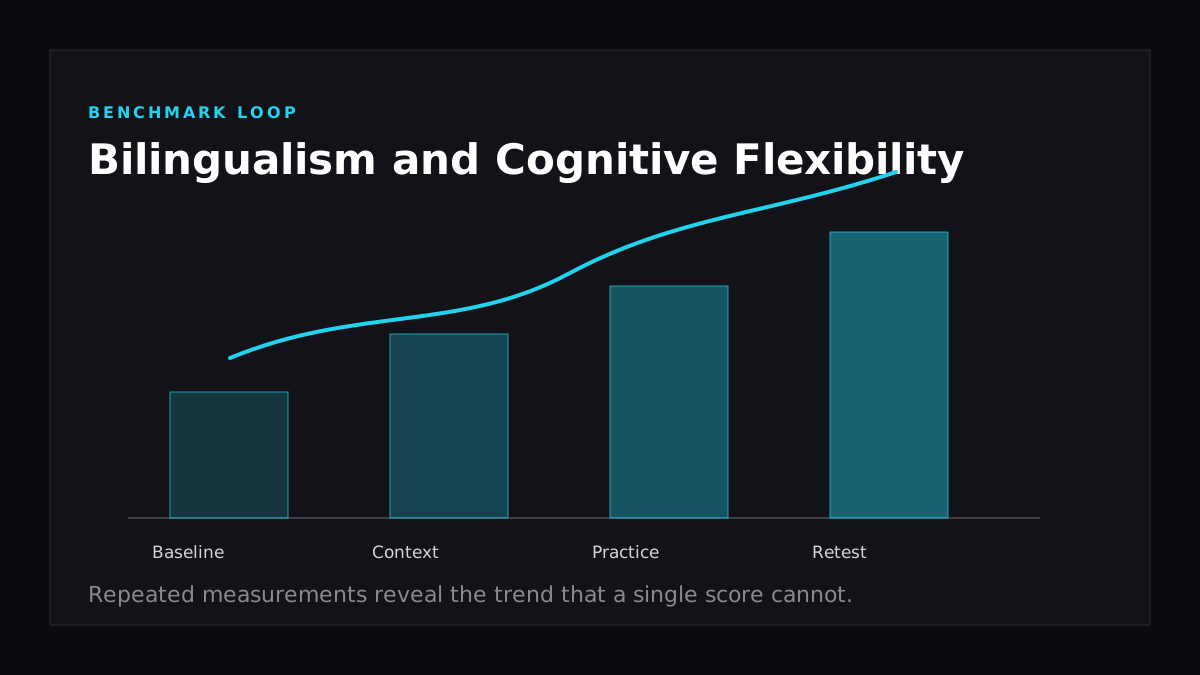
- Treat one score as a snapshot and repeated scores as the real signal.
- Use the Verbal Memory as the next measurable step.
How to Use This Guide
Use the article in three passes: scan the quick answer, check the tables or examples that match your situation, then pick one action to test this week. That keeps the article useful even if you only have a few minutes, while still giving you enough detail to come back for deeper context.
A Quick Reality Check
You've probably read that bilingualism boosts intelligence, prevents Alzheimer's, and produces dramatically smarter children. The picture is more nuanced. Some of those claims are well-supported. Others have been overstated and partially walked back as larger replication studies came in.
What follows is the honest, current state of research — what bilingualism actually does to cognition, what it doesn't, and what's still open.
What Counts as Bilingual?
Researchers distinguish several categories:
- Simultaneous bilinguals — exposed to both languages from birth or before age 3
- Sequential bilinguals — learned a second language after early childhood
- Balanced bilinguals — equally fluent in both languages
- Dominant bilinguals — much stronger in one language
The cognitive effects vary across these groups. Simultaneous, balanced bilinguals show the strongest effects; late, dominant bilinguals show smaller and less consistent effects.
This matters because most "bilingualism studies" lump these groups together, which is part of why findings are inconsistent.
What's Genuinely Different About the Bilingual Brain
Stronger executive function in conflict tasks
The most replicated finding: bilinguals tend to outperform monolinguals on tasks that require inhibiting irrelevant information and switching between rules. The classic example is the Stroop task, where you must name the color of a word that spells a different color (e.g., the word "RED" written in blue ink).
The proposed mechanism: bilinguals constantly suppress one language while using the other, which trains the same neural circuits used for general inhibitory control. The brain doesn't fully shut off the unused language — it actively suppresses it.
Better mental flexibility
Bilinguals show small but consistent advantages on tasks that require switching between rules or perspectives mid-task. The effect appears across the lifespan.
You can probe your own flexibility informally with the BrainRivals Verbal Memory Test, which requires constantly updating your mental record of which words you've seen.
Different processing of attention
Brain imaging studies show bilinguals recruit slightly different neural networks for attention tasks — more efficient, with less prefrontal activation needed for the same performance level. This is one of the cleaner findings: bilinguals' brains aren't "smarter," they're routing attention through different, often more efficient circuits.
Reduced verbal fluency in each individual language
This is the trade-off rarely highlighted in pop-science articles: bilinguals consistently score lower on tests of vocabulary, word retrieval, and verbal fluency in each individual language compared to monolinguals.
The total vocabulary across both languages is typically larger than monolinguals' single-language vocabulary, but per-language fluency is reduced.
What's More Modest Than Claimed
The Alzheimer's protection claim
Early studies suggested bilingualism delayed dementia onset by 4–5 years. This was a striking finding that captured public attention.
Subsequent research has been mixed. Larger studies and meta-analyses suggest:
- A real but smaller effect — perhaps 1–3 years of delay on average
- Stronger effects in lifelong, balanced bilinguals than late or dominant bilinguals
- The effect is one of "cognitive reserve" — bilingualism doesn't prevent the disease, it delays the point at which symptoms appear despite ongoing pathology
- Lifestyle confounds (education, socioeconomic status) account for some of the early effect sizes
The consensus today: bilingualism contributes modestly to cognitive reserve, alongside education, social engagement, exercise, and other factors. It's not a magic bullet.
The "bilingualism makes you smarter" claim
This was probably oversold. The cognitive effects are real but specific to certain tasks (executive control, switching, inhibition). Bilinguals don't show advantages on most standardized intelligence measures, and they don't show better academic performance on average once socioeconomic factors are controlled.
The honest summary: bilingualism is one of many cognitive enrichments. It produces specific advantages, not a general intelligence boost.
What's Still Genuinely Open
Whether the executive function advantage is robust
A 2014 paper by de Bruin et al. analyzed publication bias in bilingualism research and found that studies not finding the executive function advantage were less likely to be published. This raised questions about the size of the effect.
Larger pre-registered studies since then have found smaller effects than the original literature suggested, but most still find some advantage. The current consensus: real, but smaller than first claimed, and dependent on the specific task.
Whether second-language learning in adulthood produces similar benefits
Most of the cognitive advantages are documented in lifelong bilinguals. Adults learning a second language show some of the same effects, but the magnitude and durability are unclear.
What is clear: serious adult language learning produces measurable changes in brain structure (gray matter density in language and attention regions) within months. Whether those changes translate to general cognitive benefits is less settled.
The Verbal Memory Connection
Bilingualism interacts with verbal memory in interesting ways:
- Bilinguals show slightly different encoding patterns when learning new words — they often anchor new vocabulary across both language systems
- Word retrieval is slower (the "tip of the tongue" effect is more frequent in bilinguals)
- Long-term retention of vocabulary is similar to or better than monolinguals
- Cross-language priming effects are robust — a word in one language can speed retrieval of a related word in the other
If you're bilingual and want to track verbal memory over time, the BrainRivals Verbal Memory Test provides consistent baselines, though performance will vary by which language is being tested in your head as you play.
Practical Implications
For monolingual adults considering language learning
The cognitive case for learning a second language as an adult is real but modest. Stronger reasons to learn a second language:
- Genuine interest in the culture or use case
- Employment or relocation requirements
- Maintaining cognitive engagement in retirement (alongside other activities)
- The intrinsic experience of bilingual cognition
Weaker reasons:
- Hoping for general intelligence boost
- Hoping for guaranteed Alzheimer's prevention
For parents of bilingual children
The cognitive evidence is favorable but the academic evidence is mixed. Bilingual children:
- Develop language milestones at the same overall pace, with each language individually slightly delayed
- Show executive function advantages in early childhood
- Catch up academically once they reach full proficiency in the school language
- Don't show negative cognitive effects from being bilingual
The trade-offs are real (per-language vocabulary is smaller in early years), but the long-term picture is positive.
For older adults
Maintaining or learning a second language is a reasonable component of cognitive engagement in older adulthood, especially as part of a broader package (social engagement, exercise, novel learning). Don't expect it to be sufficient on its own.
Try It on BrainRivals
Reading about the concept is useful, but a repeatable score is more actionable. Run the Verbal Memory, Reaction Time and Number Memory tests, save your result, then repeat under similar conditions later. The trend matters more than a single best attempt.
Frequently Asked Questions
Does bilingualism delay Alzheimer's?
Recent evidence suggests a modest delay in symptom onset (1–3 years) for lifelong, balanced bilinguals. The effect appears to come from cognitive reserve — bilingualism doesn't prevent the underlying disease, but the brain is better at compensating before symptoms emerge. The effect is real but smaller than early studies suggested.
Can adults learning a new language get the same benefits?
Some, but smaller and less durable. Adult language learning produces measurable brain changes within months, and likely contributes to cognitive reserve. The strongest findings are for lifelong bilinguals, not adults who took up Spanish at 50.
Are bilingual children disadvantaged academically?
Not in the long run. Early in school they may show smaller per-language vocabularies and slower word retrieval, but they typically catch up by middle school, and the executive function advantages persist. The earlier-life trade-offs are real but temporary.
Does it matter how similar the languages are?
Yes, but in unexpected ways. More dissimilar language pairs (English + Mandarin) tend to produce slightly stronger executive function effects than similar pairs (Spanish + Italian) — possibly because the constant switching demand is higher.
Does code-switching count as bilingualism?
Yes — fluent code-switching demonstrates the kind of constant inhibitory control bilingualism is thought to train. Heavy code-switchers show similar cognitive profiles to balanced bilinguals.
Is "trilingual brain training" better than bilingual?
The evidence is much thinner. There's some indication that more languages produce slightly larger effects on executive function, but the relationship is non-linear and depends heavily on proficiency in each language. Three languages used at low proficiency probably matter less than two used fluently.