Spatial Awareness Tests: Train Your Brain to Visualize and Navigate 3D Space
Get the short answer first, then use the benchmarks, examples, and BrainRivals practice links to turn the idea into a measurable result.
Quick Answer
This guide turns an abstract idea about brain training into something you can notice, measure, and improve. The fastest way to use it is to read the benchmark first, compare it with your own context, then run a related BrainRivals test under the same conditions for a cleaner before-and-after signal.
Key takeaways
- Start with the practical benchmark, not the trivia.
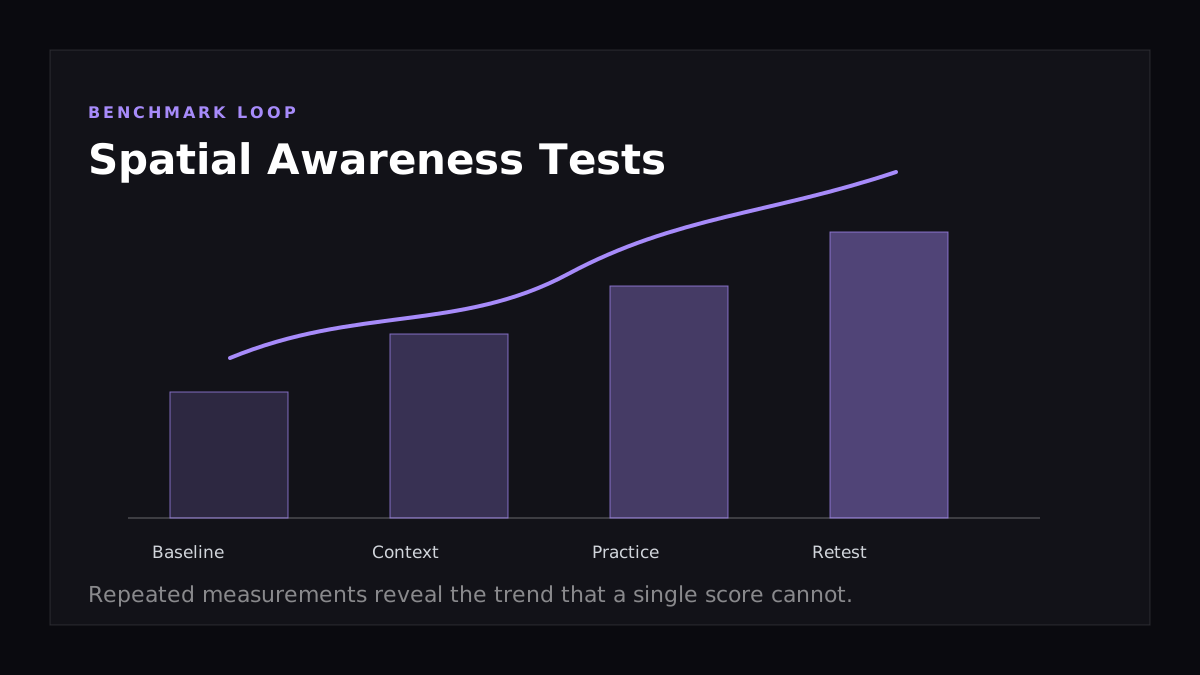
- Treat one score as a snapshot and repeated scores as the real signal.
- Use the Visual Memory as the next measurable step.
How to Use This Guide
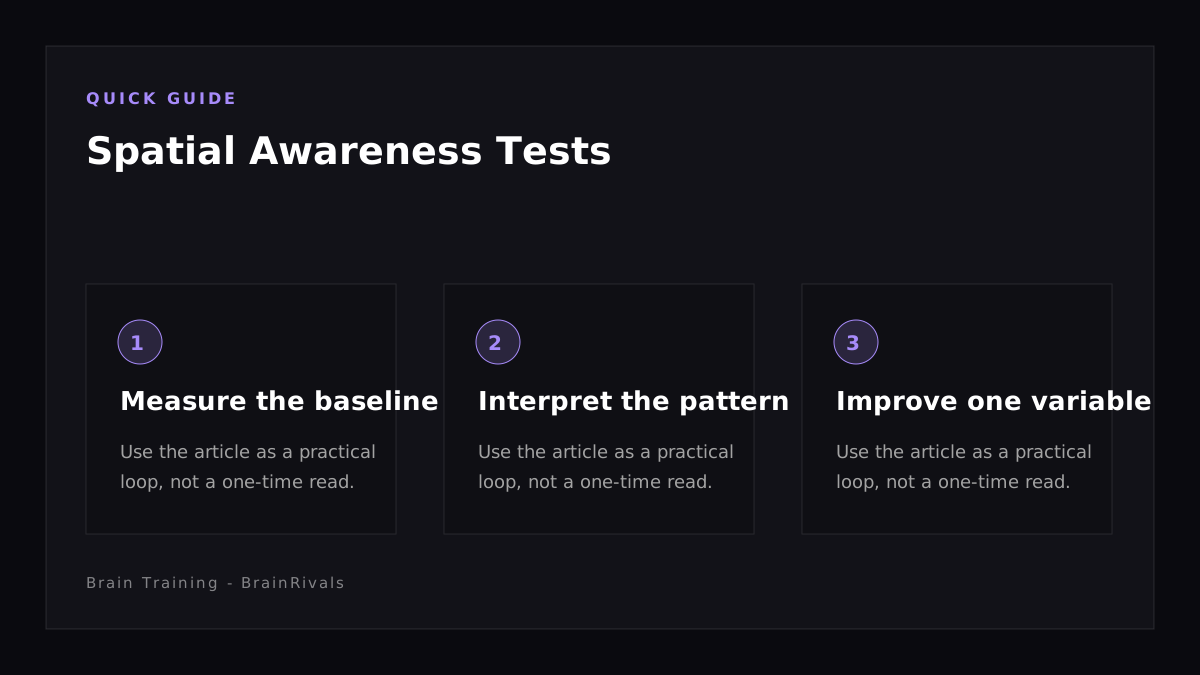
Use the article in three passes: scan the quick answer, check the tables or examples that match your situation, then pick one action to test this week. That keeps the article useful even if you only have a few minutes, while still giving you enough detail to come back for deeper context.
Close your eyes. Picture your childhood bedroom. Now mentally rotate 90 degrees. What's to your right? What's above?
If you found that easy, you have strong spatial awareness. If it felt hard or you couldn't do it, don't worry—spatial awareness is trainable, and improvements transfer directly to real-world performance.
Spatial reasoning is underrated. Most cognitive training focuses on memory and pattern recognition. But spatial awareness is equally fundamental, and for certain careers and skills, it's the bottleneck.
What Is Spatial Awareness?
Spatial awareness is your ability to mentally represent, manipulate, and navigate three-dimensional space. It includes:
Mental Rotation: Visualizing how an object looks from different angles without physically rotating it.
Spatial Relations: Understanding how objects relate positionally—above, below, left, right, inside, outside, occluded.
Navigation: Building and updating internal maps of environments. Knowing where you are and how to get somewhere without external landmarks.
Visualization: Creating and manipulating mental images. Imagining a structure from a blueprint, or how furniture will fit in a room.
All of these depend on a spatial representation system in your brain—primarily the parietal cortex and specific areas of the prefrontal cortex.
Why Spatial Awareness Matters
Spatial reasoning predicts success in domains people don't always associate with "space":
Engineering and Architecture: Designing structures, reading technical drawings, and understanding load distributions all require rapid mental rotation and spatial visualization. Engineers with high spatial ability solve design problems faster and make fewer costly errors.
Surgery: Surgeons must mentally model internal anatomy, anticipate how tissues will move, and work in 3D space with limited visual access. Spatial ability directly predicts surgical skill and patient outcomes.
Programming and Mathematics: Debugging code, visualizing data structures (trees, graphs, networks), and understanding higher-dimensional concepts all depend on spatial reasoning. Strong spatial ability correlates with better performance in computer science and advanced math.
Gaming and Sports: Video game players develop exceptional spatial awareness through practice. This transfers to real-world navigation, 3D reasoning, and hand-eye coordination. Athletes in spatial sports (tennis, baseball, soccer) have higher spatial ability than non-athletes.
Navigation and Wayfinding: Beyond obvious cases like taxi drivers or pilots, spatial awareness helps you navigate novel environments, remember where you parked, and mentally plan routes.
Design, Art, and Aesthetics: Designers, architects, and artists use spatial reasoning constantly. Even non-professionals benefit from spatial training when arranging furniture, composing photos, or organizing space.
The surprising finding: spatial ability is more trainable than IQ. Training spatial reasoning produces larger, faster gains than training pattern recognition or memory. And those gains transfer to the real-world domains mentioned above.
How Visual Memory Tests Measure Spatial Awareness
The Visual Memory test at BrainRivals measures spatial awareness implicitly. Here's why:
You're shown a grid of tiles, some highlighted, then they disappear. You must recall which positions were highlighted. This seems like pure memory. But high performers extract spatial patterns rather than memorizing individual positions.
Spatial patterns include:
- Geometric arrangements (corners, edges, diagonals)
- Symmetries (left-right, top-bottom)
- Distance relationships (which items are near each other)
- Clusters (groups of highlighted tiles)
People who abstract spatial structure perform better and improve faster than people who try to memorize positions independently. The test rewards spatial reasoning as much as memory.
Advanced levels increase spatial complexity. You're not just recalling positions; you're reasoning about spatial layouts under cognitive load. This drives spatial visualization improvements.
Training Spatial Awareness: Practical Techniques
Mental Rotation Exercises
The single most effective spatial training is systematic mental rotation practice.
Procedure:
- Take a 3D object (real or imagined). Common starting objects: a cube with different patterns on each face, a letter of the alphabet, a hand.
- Mentally rotate it 45 degrees around the vertical axis. Visualize clearly.
- Rotate 90 degrees. Then 180. Then 270.
- Rotate around different axes (horizontal, front-to-back).
- Increase speed. Eventually you should complete rotations in seconds.
Research shows 10–15 minutes of daily mental rotation practice, sustained for 4–6 weeks, produces significant improvements in spatial tests. Gains transfer to novel rotation tasks, suggesting that you're building a general spatial skill, not memorizing specific objects.
Start with simple objects. Difficulty includes:
- Complex shapes (Tetris pieces, 3D puzzles)
- Objects with multiple colors or patterns
- Simultaneous rotation around multiple axes
- Very fast rotations (15 seconds to rotate 360 degrees)
The Tetris Effect
Playing Tetris—and particularly training extensively on Tetris-like games—builds spatial reasoning rapidly. Tetris forces constant mental rotation, visualization, and spatial planning. Studies show that people who play Tetris 20–30 minutes daily for weeks show measurable gains on spatial tests, including improved mental rotation speed and accuracy.
The benefit isn't specific to Tetris; it transfers to other spatial tasks. Why? Because Tetris trains the core skill: rapid mental rotation under time pressure.
Variants that are even more effective:
- 3D Tetris variants: Add another dimension, forcing you to visualize truly 3D rotations
- Bloxorz or similar puzzles: Require spatial planning, not just rotation
- Rubik's Cube: Combines rotation with constraint satisfaction and planning
Navigation and Wayfinding Practice
Build and update mental maps by:
Exploring novel environments: Walking a new city without GPS or a map. Pay attention to landmarks, cardinal directions, and spatial relationships. Later, try to mentally navigate from memory.
Mental navigation exercises: Close your eyes and navigate a familiar environment (your home, your usual work route) mentally. Describe in detail what you'd encounter.
Map reading and learning: Study a map, close it, and try to reproduce it from memory. Then navigate using only your mental map.
This trains the navigation-specific spatial system (primarily the hippocampus and parahippocampal cortex), which is distinct from mental rotation but equally important.
Visual Pattern Recognition
The Visual Memory test itself is training. Playing progressively difficult versions forces you to extract spatial structure rather than memorize individual positions. This builds your spatial pattern recognition.
Enhance this by:
- Deliberately looking for geometric patterns in highlighted positions
- Noticing symmetries and regularities
- Thinking about distances between items
- Grouping items into spatial clusters
This metacognitive approach—consciously analyzing spatial structure—accelerates learning compared to passive practice.
Why Some People Are Naturally Better
Spatial ability has both genetic and experiential components.
Genetics: About 50% of spatial ability variance is heritable. Some people's brains are naturally wired for efficient spatial processing.
Experience: The other 50% is learnable. Childhood play, especially constructive play (LEGO, building blocks, puzzles), builds spatial skills. Video gaming, sports, and navigation experience all contribute.
The important implication: your starting level doesn't determine your potential. People who start with poor spatial awareness improve faster than those who start strong, suggesting ceiling effects for naturals and room for growth for beginners.
Timing and Consistency
Spatial training requires consistency more than duration. 10 minutes daily for 6 weeks beats 2 hours once a week.
Why? Spatial skills consolidate through repeated, progressive practice. Your brain needs time to encode patterns and build neural connections. Cramming doesn't work as well.
Recommended approach:
- Week 1–2: 10 minutes daily on mental rotation basics
- Week 3–4: 10 minutes daily on intermediate difficulty; start Visual Memory testing
- Week 5–6: 10 minutes daily on advanced rotation; progressive Visual Memory levels
- Week 7+: Maintain with 5–10 minutes daily; increases transfer and prevents decay
The Transfer Question
Do spatial skills trained in one domain transfer to others?
Yes, with caveats: Mental rotation training transfers to other rotation tasks (>90% transfer). Navigation training transfers modestly to rotation (~30–40% transfer). Gaming transfers broadly because it combines rotation, navigation, and real-time spatial reasoning.
The lesson: train multiple types of spatial skills (rotation, navigation, visualization, pattern recognition) rather than specializing. This builds broader spatial reasoning that transfers better.
The Practical Takeaway
Spatial awareness is learnable, trainable, and transferable. If your career involves design, engineering, surgery, programming, or navigation, spatial training is worth your time—returns are larger than most other cognitive training.
Even if your career doesn't require spatial reasoning, training it has benefits. You navigate better, you remember layouts more clearly, and you build a richer mental representation of the world.
The best entry point: consistent mental rotation practice, supported by games like Tetris or Bloxorz, and regular Visual Memory testing to track progress.
Start measuring your spatial reasoning now. The Visual Memory test will challenge your ability to extract patterns from spatial layouts—a core component of spatial awareness that translates directly to real-world visualization and navigation.
Try It on BrainRivals
Reading about the concept is useful, but a repeatable score is more actionable. Run the Visual Memory and Visual Acuity tests, save your result, then repeat under similar conditions later. The trend matters more than a single best attempt.