How Fast Is the Human Brain? Reaction Speed Explained
Get the short answer first, then use the benchmarks, examples, and BrainRivals practice links to turn the idea into a measurable result.
Quick Answer
This guide turns an abstract idea about reaction speed into something you can notice, measure, and improve. The fastest way to use it is to read the benchmark first, compare it with your own context, then run a related BrainRivals test under the same conditions for a cleaner before-and-after signal.
Key takeaways
- Start with the practical benchmark, not the trivia.
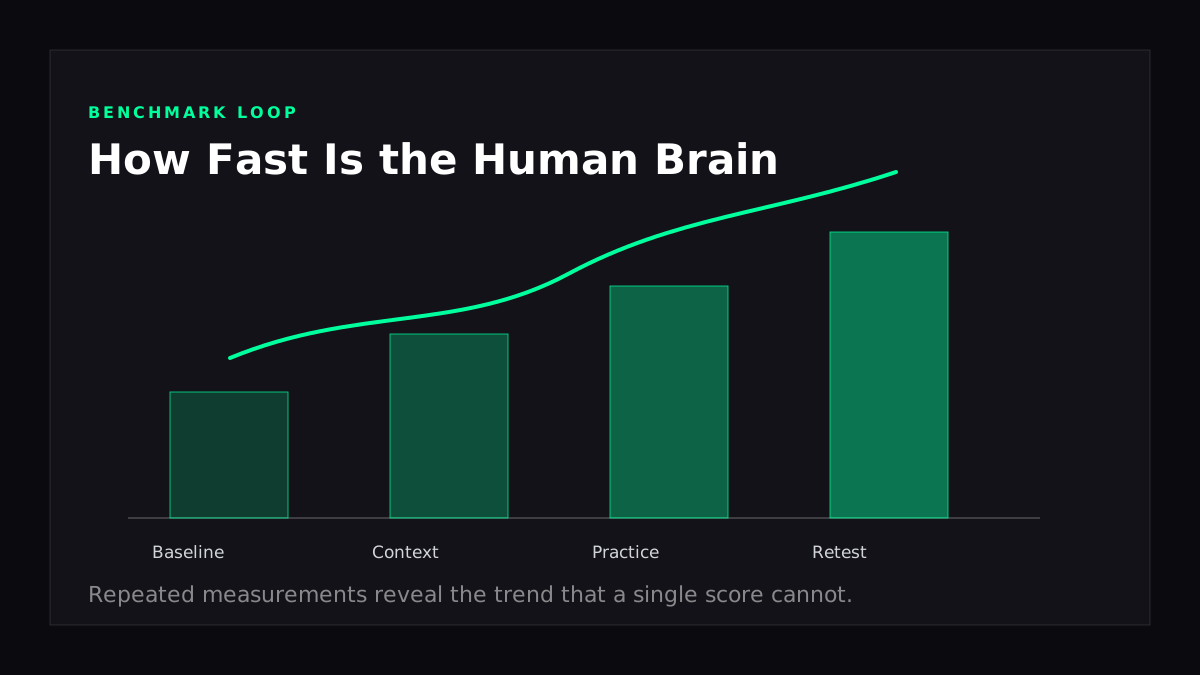
- Treat one score as a snapshot and repeated scores as the real signal.
- Use the Reaction Time as the next measurable step.
How to Use This Guide
Use the article in three passes: scan the quick answer, check the tables or examples that match your situation, then pick one action to test this week. That keeps the article useful even if you only have a few minutes, while still giving you enough detail to come back for deeper context.
The Question: How Fast Is the Brain?
When people ask "how fast is the human brain?", they often expect a single number — like clock speed on a computer processor. The reality is that the brain operates at many different speeds simultaneously, with different processes running at radically different timescales.
Some neural events happen in microseconds (0.001ms). Others take seconds. Reaction time — the most commonly tested measure of brain speed — sits at around 250 milliseconds for a healthy adult. Understanding why reaction time is what it is requires a journey through the neural pathways from eye to brain to muscle.
Step 1: Light Hits the Retina (0ms)
The moment a stimulus appears — say, the BrainRivals screen turns green — light photons hit the photoreceptors of your retina (the rods and cones at the back of your eye).
Phototransduction — the conversion of light into an electrical signal — takes approximately 50–100 milliseconds in the photoreceptors themselves. This sets a hard lower limit: no visual signal can begin its journey to the brain before this conversion is complete.
The retina then performs substantial preprocessing: detecting edges, encoding contrast, and performing a rudimentary analysis of the scene. This happens before the signal even leaves the eye.
Step 2: The Signal Travels to the Brain (50–70ms)
From the retina, the signal travels along the optic nerve to the brain's visual processing centres. Signals in myelinated nerve fibres (wrapped in a fatty insulating sheath) travel at approximately 70–120 metres per second — fast, but not instantaneous.
The primary visual processing pathway is:
Retina → Optic nerve → Lateral geniculate nucleus (LGN) → Primary visual cortex (V1)
The LGN, located in the thalamus, acts as a relay station, routing signals to the appropriate cortical areas. By the time the signal reaches V1 in the occipital lobe at the back of the brain, approximately 50–70ms have elapsed.
Crucially, the earliest signals reaching V1 are not yet conscious perception — they represent low-level features like orientation, contrast, and colour. Conscious awareness of the stimulus requires further processing in higher cortical areas.
Step 3: Visual Processing in the Cortex (70–150ms)
The visual cortex is not a single area but a hierarchy of over 30 interconnected regions, each extracting progressively more complex features from the raw signal:
| Brain Area | Processes | Latency |
|---|---|---|
| V1 (primary visual cortex) | Edges, orientation, contrast | 50–80ms |
| V2/V3 | Motion, depth, shape | 80–100ms |
| V4 | Colour, object recognition | 90–120ms |
| IT cortex (temporal lobe) | Object identity, face recognition | 100–150ms |
| Parietal cortex | Spatial location, "where" | 80–130ms |
By ~150ms, your brain has a fairly complete conscious representation of what it's seeing and where it is. This is when most people become consciously aware of the stimulus.
Step 4: Decision and Response Selection (100–150ms cumulative from detection)
Knowing what you're seeing isn't the same as deciding to act. Between perception and movement, the brain must:
- Evaluate the stimulus against a prepared response rule ("if green, click")
- Select the appropriate motor response from possible options
- Prepare the motor command by activating the relevant muscle groups in sequence
- Initiate the motor programme through the primary motor cortex
The prefrontal cortex and supplementary motor area (SMA) handle the decision and preparation phases. The SMA, in particular, shows a characteristic electrical readiness potential — the Bereitschaftspotential — that begins building 500–1,000ms before a voluntary movement, even though the actual response happens much later. This represents unconscious motor preparation.
In simple reaction tasks (just one possible response), this decision phase is fast (~50ms). In choice reaction tasks (multiple possible responses), it can add 100–200ms per additional option — a phenomenon described by Hick's Law.
Step 5: The Motor Signal Travels to the Muscles (150–220ms)
Once the motor command is generated in the primary motor cortex, it must travel down the spinal cord and through peripheral nerves to the hand muscles.
This motor pathway — the corticospinal tract — is among the fastest in the nervous system, with large, heavily myelinated fibres conducting signals at 60–80 metres per second. Still, the distance from brain to hand (approximately 1 metre in an adult) means this journey takes approximately 20–30ms.
At the neuromuscular junction, the nerve signal triggers the release of acetylcholine, which binds to muscle receptors and initiates contraction. This final step adds another 5–10ms.
Step 6: Muscle Contraction and Physical Response (220–250ms)
Muscle contraction is not instantaneous. The electrical signal must propagate across the muscle fibre surface, trigger calcium release, and initiate the actin-myosin crossbridge cycle that produces force. This electromechanical delay of 15–30ms is why measured reaction times are always longer than pure neural processing would predict.
By the time the mouse button physically moves, approximately 240–260ms have elapsed from stimulus onset — the familiar average reaction time.
The Full Timeline
| Phase | Process | Time |
|---|---|---|
| Phototransduction | Light → electrical signal in retina | 0–50ms |
| Optic nerve conduction | Retina → brain (LGN) | 50–70ms |
| Early cortical processing | V1 → higher visual areas | 70–130ms |
| Conscious perception | Integrated visual awareness | ~150ms |
| Decision and preparation | Prefrontal + motor cortex | 150–200ms |
| Motor signal to hand | Motor cortex → spinal cord → muscles | 200–230ms |
| Muscle contraction | Electromechanical delay | 230–250ms |
| Total | Stimulus → physical response | ~250ms |
Why Can't We React Faster?
Given that early visual signals reach the brain in 50ms, why does it take 250ms to press a button? The bottlenecks are:
Phototransduction is inherently slow: The photochemical process converting light to electricity in photoreceptors is rate-limited by chemistry, not physics. It cannot be sped up by training.
Conscious perception requires extensive processing: Reacting to a stimulus requires knowing what the stimulus is, not just that something changed. This higher-level processing takes additional time even after the first signals arrive.
Motor preparation has a fixed minimum duration: The brain cannot execute a voluntary movement instantaneously — it must prepare a motor programme, which takes time even when the decision is simple.
Neural conduction velocity has a ceiling: Myelinated nerves conduct at a maximum of approximately 70–120 m/s. There's no biological mechanism to significantly exceed this.
What training can do is compress the decision and preparation phases by making the stimulus-response mapping more automatic, reducing the cognitive work required in the middle of the chain.
How the Brain Cheats: Prediction and Anticipation
The brain doesn't passively wait for stimuli — it actively predicts what's coming next and pre-prepares responses. This predictive processing is why experienced drivers brake before consciously registering the car in front stopping, and why batters in cricket begin their swing before the ball reaches them.
Predictive coding: The brain continuously generates predictions about incoming sensory information based on context and experience. When the prediction is correct, processing is faster because the brain doesn't need to process the stimulus from scratch — it just confirms the prediction.
Pre-motor preparation: The SMA begins building motor readiness potential before a predictable stimulus occurs. When the stimulus arrives, the response is partially pre-built, dramatically reducing effective reaction time.
This is why anticipatory reactions can appear faster than the biological minimum: the person isn't truly reacting after stimulus onset — they're executing a pre-prepared action that happens to coincide with the stimulus.
The Fastest and Slowest Neural Processes
To put reaction time in context:
| Neural Process | Speed |
|---|---|
| Spinal reflex arc (e.g., knee-jerk) | 20–50ms |
| Startle reflex | 50–100ms |
| Simple auditory reaction | 150–180ms |
| Simple visual reaction | 220–260ms |
| Choice reaction (2 options) | 280–350ms |
| Complex decision-making | Seconds to hours |
| Long-term memory consolidation | Hours to years |
The spinal reflex is the nervous system's "fastest mode" — it bypasses the brain entirely, routing through a simple spinal cord circuit. This is why the knee-jerk reflex is used clinically to test spinal cord integrity.
Testing Your Own Brain Speed
The most direct way to measure your personal neural processing speed is the BrainRivals Reaction Time Test. Each attempt measures the gap between the screen turning green and your click — a clean measure of visual reaction time that spans all six phases described above.
Your score is benchmarked against a global population and assigned a tier from Bronze (350ms+) to Elite (under 150ms). The difference between tiers reflects genuine differences in neural efficiency — whether from genetics, training, age, or lifestyle factors.
Try It on BrainRivals
Reading about the concept is useful, but a repeatable score is more actionable. Run the Reaction Time test, save your result, then repeat under similar conditions later. The trend matters more than a single best attempt.
Frequently Asked Questions
How fast do nerve signals travel in the body?
Nerve conduction velocity depends on whether a nerve is myelinated and its fibre diameter. The fastest myelinated fibres (Aα) conduct at 70–120 m/s. Unmyelinated fibres (C fibres, carrying slow pain and temperature) conduct at only 0.5–2 m/s — explaining why you feel a sharp impact immediately but burning pain arrives seconds later.
Is the brain faster than a computer?
For specific tasks, modern computers massively outperform the brain (a GPU can perform trillions of arithmetic operations per second). But the brain excels at massively parallel processing, pattern recognition in noisy environments, and efficient energy use — consuming only ~20 watts while outperforming supercomputers at tasks like face recognition and natural language understanding.
Why are auditory reactions faster than visual ones?
The auditory pathway to the cortex involves fewer synaptic relays and shorter conduction distances than the visual pathway. Auditory signals reach the auditory cortex in approximately 8–10ms, versus 50–70ms for visual signals to reach V1. This speed advantage is why starting pistols produce faster athletic starts than light signals.
What happens to brain processing speed with age?
Neural conduction velocity decreases slightly with age due to myelin sheath thinning. More significantly, cognitive processing in the prefrontal cortex — the decision and preparation phase — slows with age. This is why reaction times increase gradually from the mid-twenties onward. Aerobic exercise, sleep, and cognitive training buffer this decline significantly.
Can you consciously experience a 250ms reaction time?
No — by the time you consciously decide to react and execute the movement, it's done. The subjective experience of "reacting" is a retrospective narrative constructed by consciousness after the fact. Much of what we call deliberate action is actually executed by the motor system before conscious awareness catches up. This is related to the "free will" experiments of Benjamin Libet, which found that motor preparation precedes conscious intention by 300–500ms.