What Is a Good Reaction Time? Average Scores Explained
Get the short answer first, then use the benchmarks, examples, and BrainRivals practice links to turn the idea into a measurable result.
Quick Answer
This guide turns an abstract idea about reaction speed into something you can notice, measure, and improve. The fastest way to use it is to read the benchmark first, compare it with your own context, then run a related BrainRivals test under the same conditions for a cleaner before-and-after signal.
Key takeaways
- Start with the practical benchmark, not the trivia.
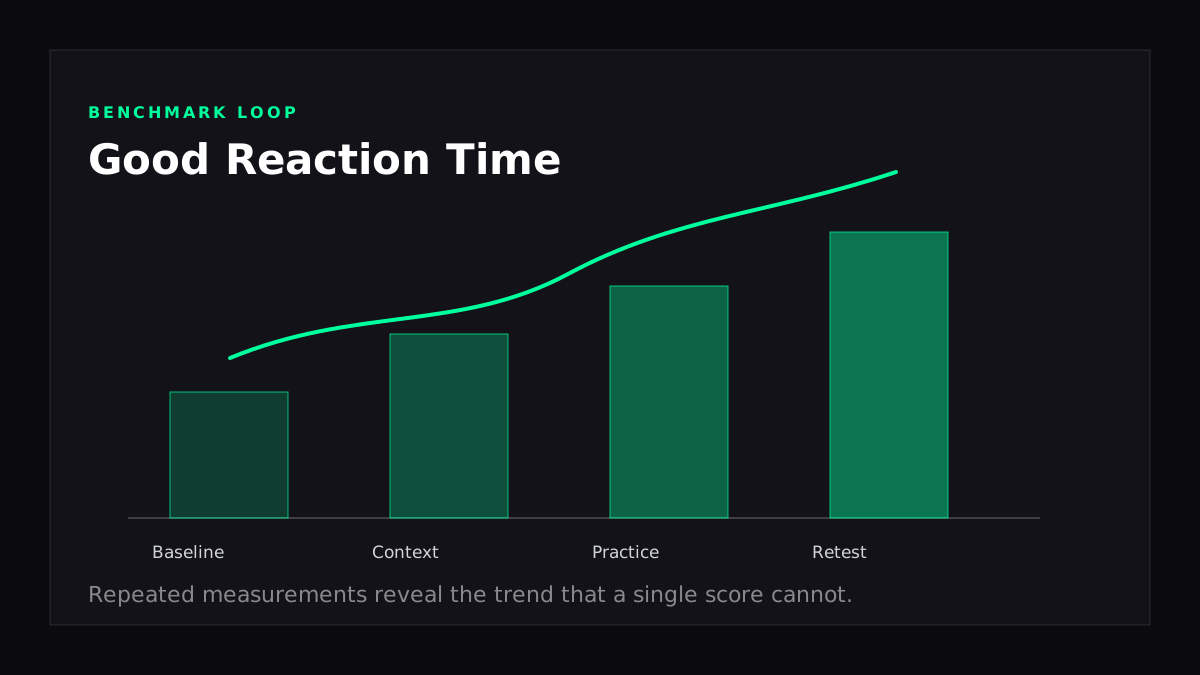
- Treat one score as a snapshot and repeated scores as the real signal.
- Use the Reaction Time as the next measurable step.
How to Use This Guide
Use the article in three passes: scan the quick answer, check the tables or examples that match your situation, then pick one action to test this week. That keeps the article useful even if you only have a few minutes, while still giving you enough detail to come back for deeper context.
What Is Reaction Time?
Reaction time is the interval between a stimulus appearing and your response to it. In everyday life this plays out constantly — braking when a car stops in front of you, clicking on a moving target in a game, or catching something as it falls off a table.
On BrainRivals, the Reaction Time Test measures this precisely: a screen turns from red to green at a random moment, and you click (or press Space) as fast as possible. The gap between the colour change and your click — measured in milliseconds — is your reaction time.
What Is the Average Reaction Time?
Research consistently places the average simple visual reaction time for healthy adults between 200ms and 300ms, with the most-cited figure being around 250ms.
| Performance Level | Reaction Time | BrainRivals Tier |
|---|---|---|
| World-class (esports pro) | < 150ms | 🔴 Elite |
| Excellent | 150–199ms | 💎 Diamond |
| Average | 200–249ms | 🥇 Gold |
| Below average | 250–349ms | 🥈 Silver |
| Beginner | 350ms+ | 🥉 Bronze |
These tiers are derived from the global distribution of scores across millions of BrainRivals tests. An Elite score puts you in the top ~3% of all players worldwide.
What Affects Reaction Time?
Several factors influence how fast you react:
Age — Reaction speed peaks in the early-to-mid twenties and gradually slows after that. A 20-year-old will typically be faster than a 50-year-old by 20–40ms.
Sleep — Even mild sleep deprivation (6 hours vs. 8 hours) can add 20–50ms to your reaction time. This is why fatigued drivers are genuinely dangerous.
Caffeine — A moderate dose (100–200mg) reliably cuts reaction time by 10–30ms in most people.
Practice — Regular testing improves baseline speed through motor learning and anticipatory processing. You won't turn 300ms into 150ms, but 300ms into 240ms is realistic.
Device and display lag — A monitor with a 1ms response time gives more accurate results than a TV with 50ms input lag. Use a gaming monitor or laptop display if you want a fair score.
Stimulus type — Visual reactions (~250ms) are slower than tactile reactions (~155ms) and auditory reactions (~170ms). The BrainRivals test measures the visual modality specifically.
Is 200ms a Good Reaction Time?
Yes — 200ms is comfortably above average and puts you in the Diamond tier on BrainRivals. Competitive esports players hover between 150ms and 200ms. Professional athletes in sports like cricket batting and motor racing operate in similar ranges, though their reactions are trained for specific sport-specific stimuli.
If you're hitting 200ms consistently, you're faster than the majority of the global population.
Is 300ms a Bad Reaction Time?
Not at all — 300ms is normal. Most adults who aren't specifically training their reaction speed land in the 250ms–350ms range. The Silver tier on BrainRivals covers this range, and it represents a large portion of players.
The important thing is that reaction time is trainable. With regular practice, most people can shave 30–60ms off their baseline within weeks.
How to Test Your Reaction Time
The most accurate way to measure your reaction time at home is the BrainRivals Reaction Time Test. It uses a randomised delay before the stimulus (preventing anticipation), measures to millisecond precision, and compares your result against a global database.
Tips for an accurate test:
- Use a mouse, not a touchscreen (touchscreens add latency)
- Sit upright, rested, and focused
- Run at least 5 attempts and use the average
- Test at the same time each day for fair comparisons
Try It on BrainRivals
Reading about the concept is useful, but a repeatable score is more actionable. Run the Reaction Time test, save your result, then repeat under similar conditions later. The trend matters more than a single best attempt.
Frequently Asked Questions
What is a good reaction time for gaming?
Competitive FPS players typically average 150–200ms. Anything under 200ms gives you a meaningful edge in games like Valorant or CS2. However, reaction time is only one factor — game sense, positioning, and aim matter more at most skill levels.
What is the world record reaction time?
The lowest reliably measured simple reaction times in humans hover around 100–120ms, though anything under 150ms in a controlled test is exceptionally rare. Scores below 100ms on online tests almost always indicate anticipation (clicking before the signal), hardware lag compensation, or measurement error.
Can you improve reaction time at any age?
Yes. While the biological ceiling lowers with age, targeted practice still produces meaningful improvement at any age. Older adults who train consistently can outperform untrained younger adults in many tasks.
Does reaction time affect driving safety?
Significantly. At 100 km/h, a 250ms reaction time means your car travels 7 metres before you even begin to brake. This is why tiredness and distraction (which can push reaction times above 500ms) are so dangerous on the road.
How does BrainRivals calculate my tier?
Your raw score in milliseconds is compared against global thresholds. Elite is below 150ms, Diamond is 150–199ms, Gold is 200–249ms, Silver is 250–349ms, and Bronze is 350ms or above. These boundaries are fixed — your tier reflects your absolute performance, not your ranking relative to other players on a given day.